


Risk Management
Risks of Options Trading
A risk-first guide to time decay, leverage, assignment, liquidity, volatility, and position sizing in options trading.
Overview
Options can be powerful tools for income, hedging, speculation, and portfolio management.
But every options position carries risk.
Unlike stock investing, options introduce multiple moving parts at the same time:
- Price movement.
- Time decay.
- Implied volatility.
- Liquidity.
- Assignment exposure.
- Leverage.
- Expiration pressure.
A trader can be:
- Directionally correct.
- But still lose money.
That surprises many beginners.
Options are not automatically dangerous, but they are:
- More complex than simply buying shares.
This guide explains the major risks traders should understand before entering any options position.
It is written for education, not as a trade recommendation. Before using any options strategy, understand the contract structure, maximum realistic loss, expiration mechanics, liquidity conditions, assignment risk, and how fast exposure can change.
Why Risk Management Matters
Many beginner traders focus on:
- Potential profit.
- Premium income.
- Leverage.
- High-probability setups.
Professionals usually focus first on:
- What happens if I am wrong?
Good options trading is often less about prediction and more about:
- Controlling exposure.
- Surviving volatility.
- Managing position size.
- Avoiding catastrophic losses.
The Core Risks of Options Trading
1. Directional Risk
The underlying stock may move against the position.
Examples:
| Position | Risk |
|---|---|
| Long Call | Stock falls |
| Long Put | Stock rises |
| Covered Call | Stock collapses |
| Short Put | Stock falls sharply |
Even high-probability trades can fail.
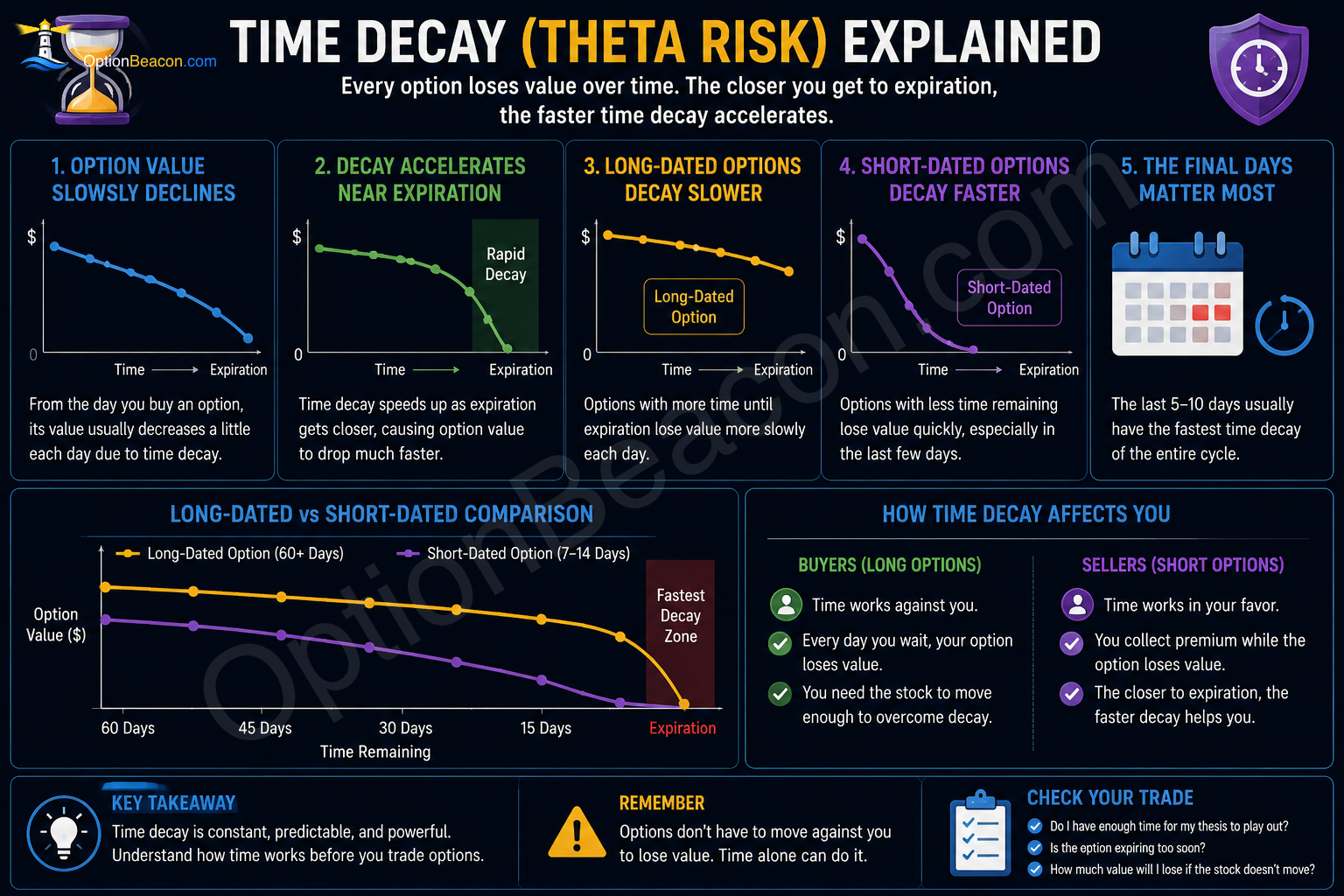
2. Time Decay (Theta Risk)
Options lose extrinsic value over time.
This decay accelerates near expiration.
Long option buyers may lose money even if:
- The stock barely moves against them.
- The thesis is delayed.
- Volatility falls.
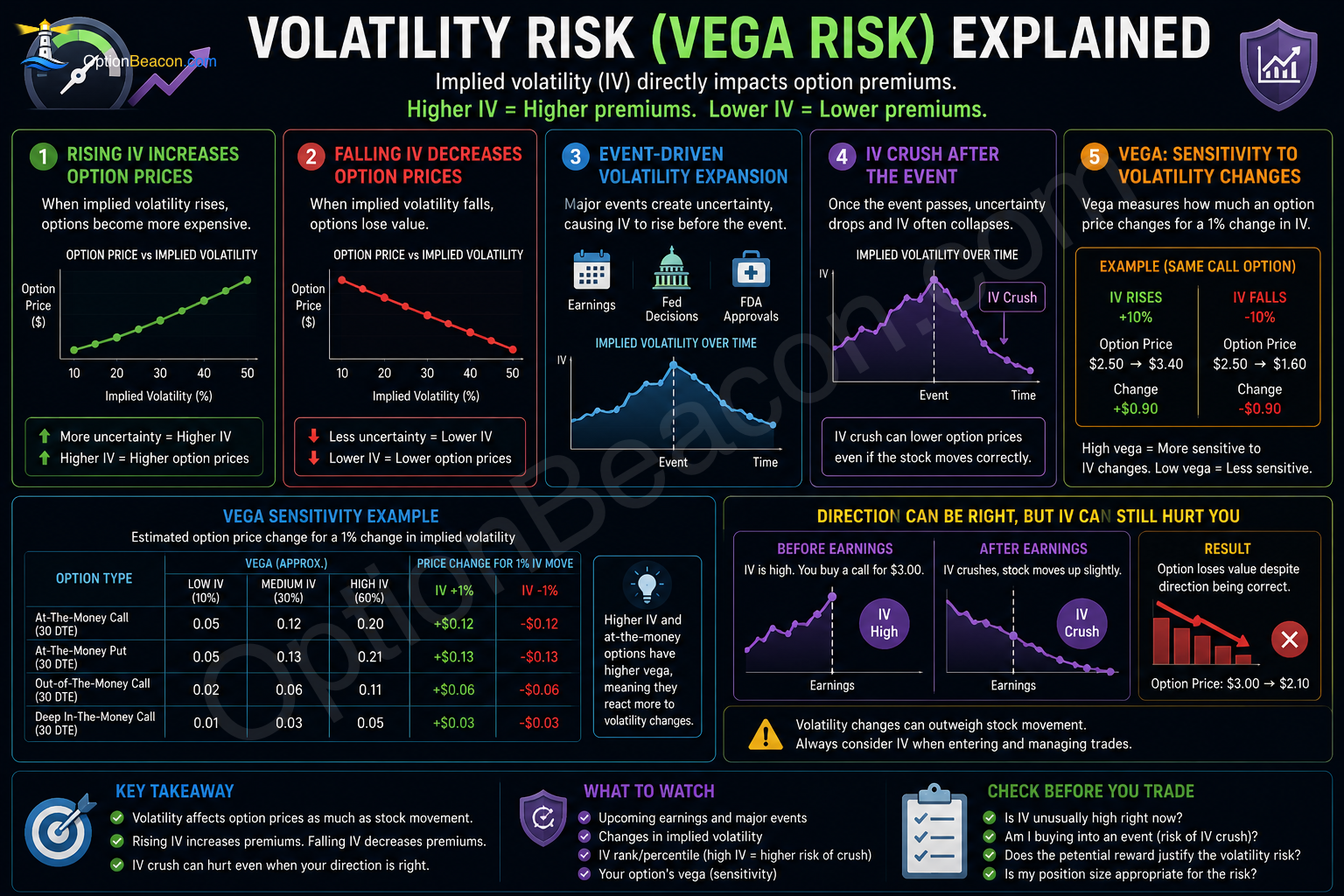
3. Volatility Risk (Vega Risk)
Implied volatility affects option pricing.
Options may become:
- More expensive during uncertainty.
- Cheaper after events.
A trader can correctly predict stock direction and still lose money because of:
- IV crush.
This commonly happens around:
- Earnings.
- FDA decisions.
- Major economic events.
4. Leverage Risk
Options provide leverage.
Small stock moves can create:
- Large percentage gains.
- Large percentage losses.
This attracts beginners, but leverage also magnifies mistakes.
Example:
- A 10% stock move might create a 70% to 100% option move.
Leverage works both ways.
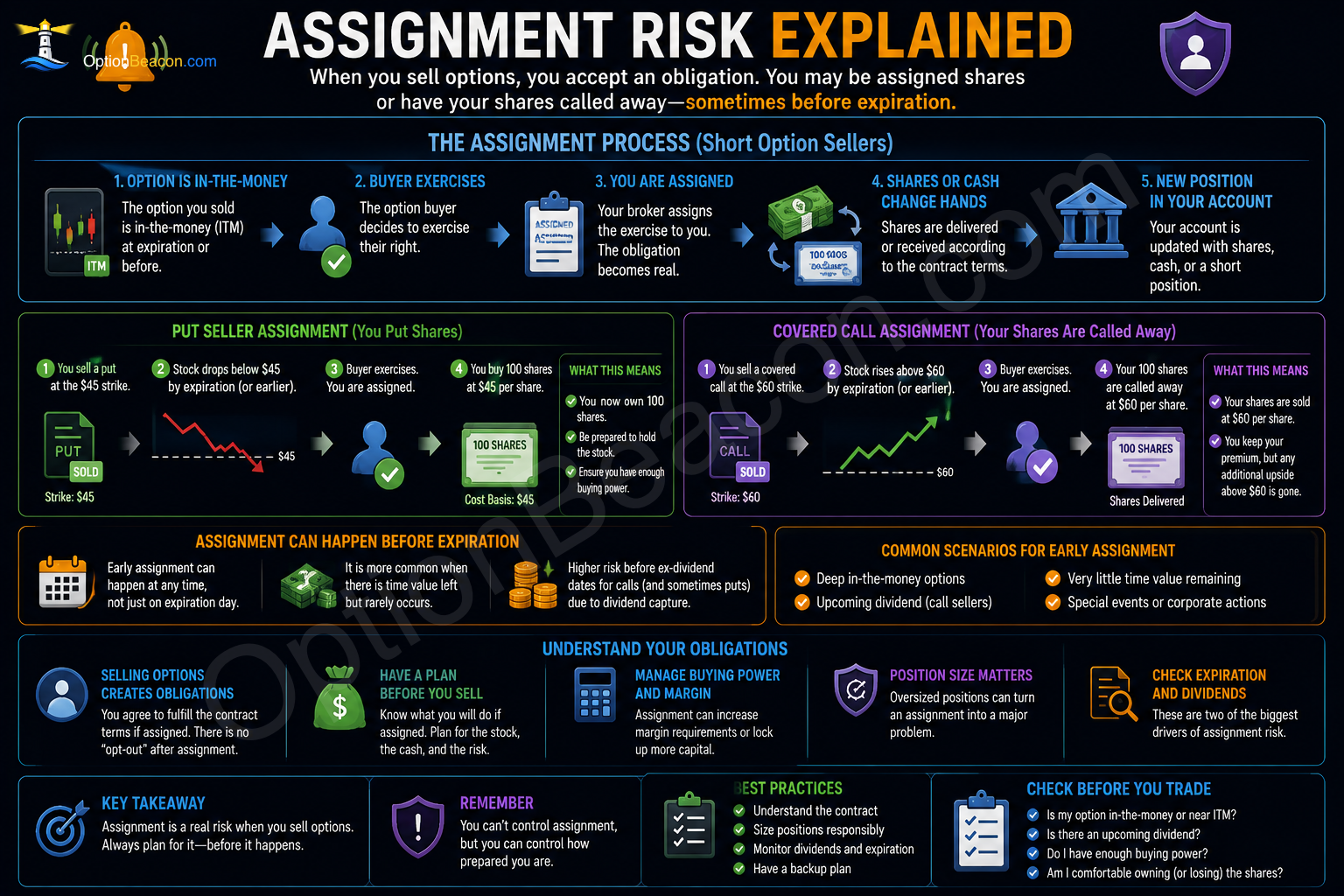
5. Assignment Risk
Short option sellers may be assigned shares.
This can happen:
- At expiration.
- Before expiration.
- Around dividends.
- During deep in-the-money conditions.
Assignment may create:
- Unexpected stock ownership.
- Short stock positions.
- Large capital requirements.
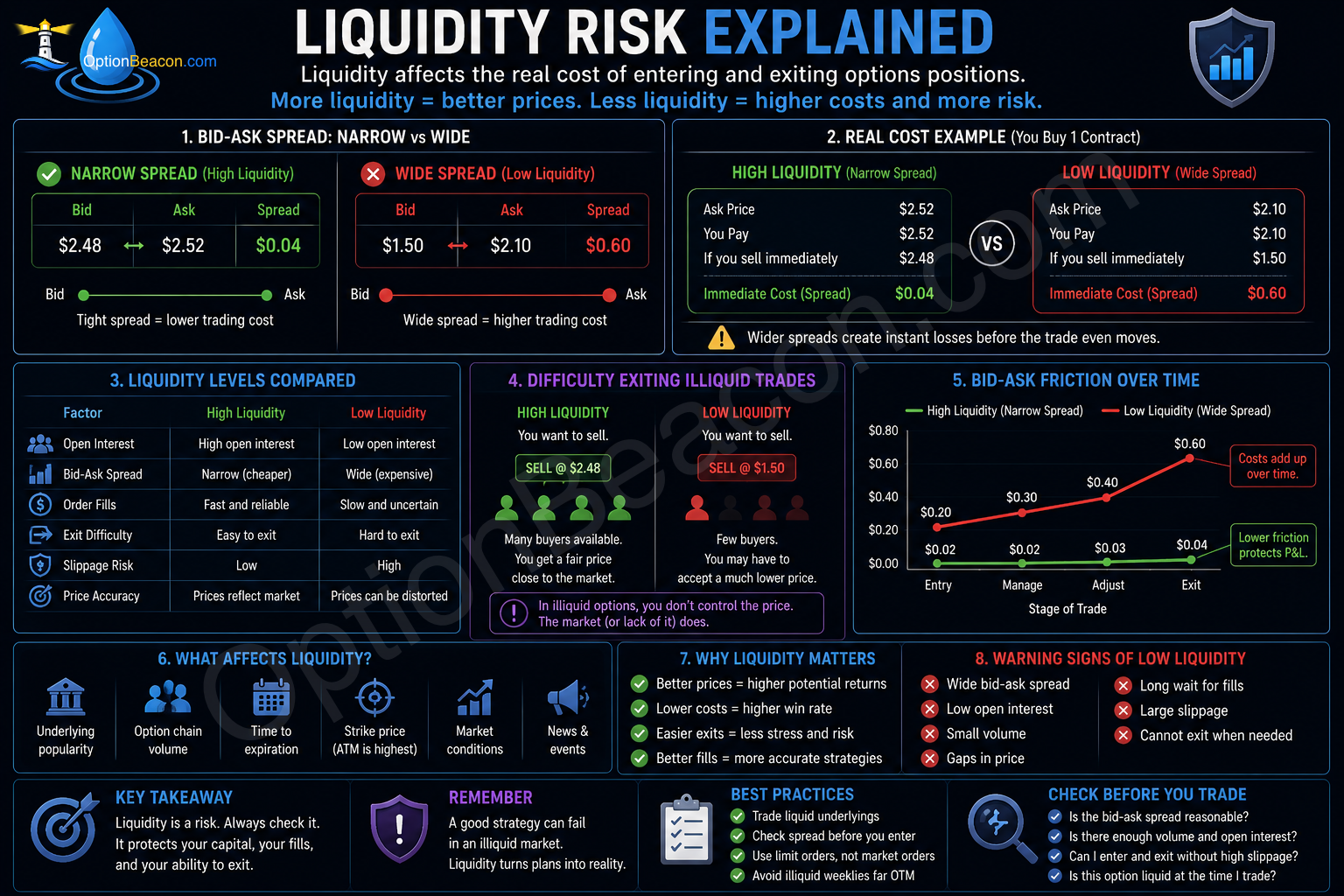
6. Liquidity Risk
Illiquid options can become expensive to trade.
Problems include:
- Wide bid-ask spreads.
- Poor fills.
- Difficult exits.
- Slippage.
A strategy may look attractive on paper but fail in real execution.
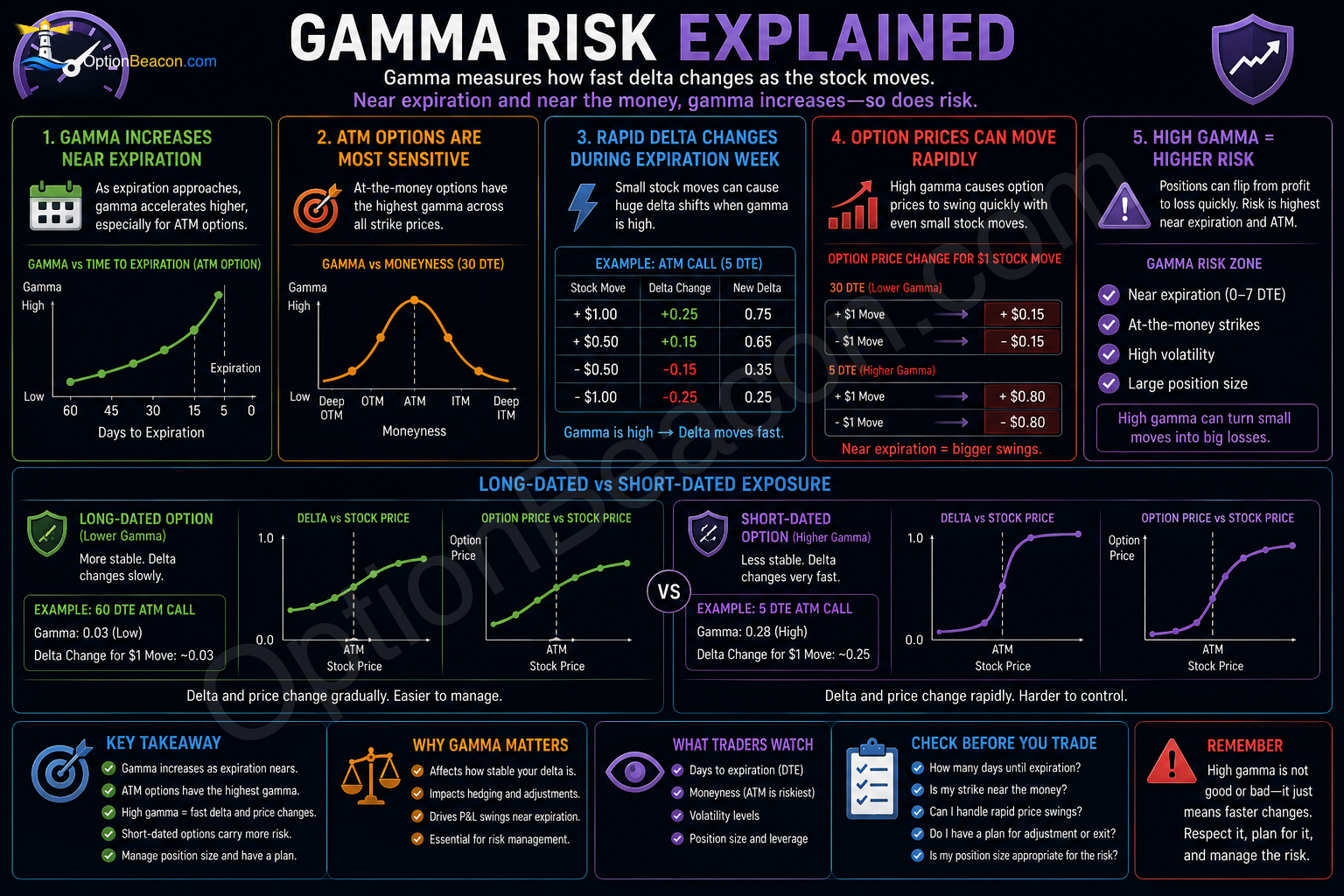
7. Gamma Risk
Gamma measures how quickly delta changes.
Gamma risk becomes larger:
- Near expiration.
- Near at-the-money strikes.
Positions can become unstable quickly during expiration week.
How Risk Changes Across Strategies
Different strategies carry different risk structures.
| Strategy | Main Risk |
|---|---|
| Long Call | Premium decay |
| Long Put | Timing and decay |
| Covered Call | Stock downside |
| Cash-Secured Put | Falling stock assignment |
| Credit Spread | Defined but still meaningful loss |
| Naked Call | Potentially unlimited risk |
Defined-risk does not mean:
- Small risk.
It only means:
- The maximum theoretical risk is known.
Real Example
A trader buys a call before earnings expecting a strong rally.
The stock rises:
- 3%.
But implied volatility collapses after earnings.
The option loses value despite the correct directional prediction.
Why?
Because option pricing depends on:
- Stock movement.
- Implied volatility.
- Time remaining.
- Strike positioning.
Examples are simplified so the mechanics are easier to see. Real trades also include commissions, fees, taxes, changing implied volatility, assignment risk, and execution quality.
Position Sizing: The Hidden Risk Multiplier
Position sizing is one of the most important risk controls.
Even good strategies become dangerous when oversized.
Professionals often risk only a small percentage of capital on one idea.
Oversized positions create:
- Emotional decision-making.
- Forced exits.
- Panic reactions.
- Inability to follow a plan.
Professional Trader Lens
Professionals usually think about risk in layers.
Before Entry
- What is the max realistic loss?
- What invalidates the thesis?
- What events are approaching?
- Is liquidity acceptable?
During the Trade
- Has volatility changed?
- Has directional exposure changed?
- Has position size become too large?
- Has assignment risk increased?
Before Expiration
- Should the trade be closed?
- Rolled?
- Assigned?
- Hedged?
A professional process usually starts with:
- Underlying analysis.
- Volatility environment.
- Risk structure.
- Expiration selection.
- Position sizing.
- Execution quality.
The option contract expresses the thesis — not the thesis itself.
Risks and Tradeoffs
Leverage Cuts Both Ways
Large percentage gains come with large percentage losses.
Time Works Against Long Buyers
Theta accelerates near expiration.
Volatility Can Override Direction
IV collapse can hurt profitable directional ideas.
Liquidity Changes Real Outcomes
Wide spreads increase hidden costs.
Assignment Can Create New Risks
Short options may become stock exposure unexpectedly.
Emotional Trading Can Escalate Losses
Hope is not a risk management plan.
Common Beginner Mistakes
Treating Options Like Lottery Tickets
Cheap contracts are not automatically good opportunities.
Ignoring Position Size
One oversized trade can damage an account quickly.
Selling Premium Blindly
High premium often signals elevated risk.
Holding Into Expiration Without a Plan
Expiration week can become highly volatile.
Confusing Defined Risk With Safe Risk
Defined-risk trades can still lose 100% of the planned amount.
Most beginner mistakes come from focusing on premium instead of total exposure.
Premium is visible immediately, but obligation, volatility, assignment exposure, and capital usage matter just as much.
A Simple Risk Framework
Before entering any trade, ask:
1. What is my thesis? 2. What breaks the thesis? 3. What is the max realistic loss? 4. What events are coming? 5. Is the position size survivable? 6. What is my exit plan?
If those answers are unclear:
- The position is probably too risky.
Practical Checklist
Before entering:
- Do you understand the max realistic loss?
- Have you checked liquidity?
- Do you understand assignment exposure?
- Have you reviewed implied volatility?
- Is expiration appropriate for the thesis?
- Is the position size manageable?
- Do you have a planned exit?
- Would you still be comfortable if volatility spikes?
Related Guides
Continue learning:
- The Greeks: Delta, Gamma, Theta, and Vega
- Options Expiration and Time Decay
- Understanding Implied Volatility
- How to Read an Options Chain
- How to Choose the Right Strike Price
Key Takeaways
- Options risk comes from multiple variables at once.
- Direction alone does not guarantee profit.
- Time decay and volatility matter.
- Leverage magnifies both gains and losses.
- Liquidity affects real execution quality.
- Assignment can create unexpected exposure.
- Position sizing is critical.
- Risk management matters more than prediction.
FAQ
Are options riskier than stocks?
They can be. Some strategies define risk clearly, while others can create large or complex obligations.
Can I lose more than the premium?
Long option buyers usually risk premium paid. Short option sellers can face much larger losses depending on structure.
What is the most important risk rule?
Know the maximum realistic loss before entering.
Why do traders lose money even when correct on direction?
Because options pricing also depends on: - Implied volatility. - Time remaining. - Liquidity. - Strike selection.
Are defined-risk spreads safe?
No strategy is completely safe. Defined-risk only means the maximum theoretical loss is known ahead of time.
What is the biggest beginner mistake?
Oversizing positions and focusing only on premium instead of total exposure. ## Educational Disclaimer OptionBeacon provides educational content only and does not provide financial, investment, or trading advice.