


Options Basics
How to Choose the Right Strike Price
Learn how strike price selection affects risk, reward, probability, premium, and assignment exposure.
Overview
Strike selection translates a market view into a contract. It affects:
- Premium.
- Probability.
- Breakeven.
- Assignment risk.
- Payoff shape.
- Directional exposure.
A strike price is not just a number. It changes how the trade behaves.
This guide explains the idea in practical terms. It is written for education, not as a trade recommendation. Before using any options strategy, understand the contract, the maximum realistic loss, the expiration date, liquidity, and what could happen if the position is assigned or exercised.
Simple Explanation
The strike price determines:
- Where an option becomes valuable.
- How expensive the contract is.
- How likely the option is to finish in the money.
- How much movement the stock needs to make.
Different strike prices express different assumptions.
A trader choosing a strike is effectively deciding:
"How much movement do I expect, and how much risk am I willing to accept?"
Understanding Strike Categories
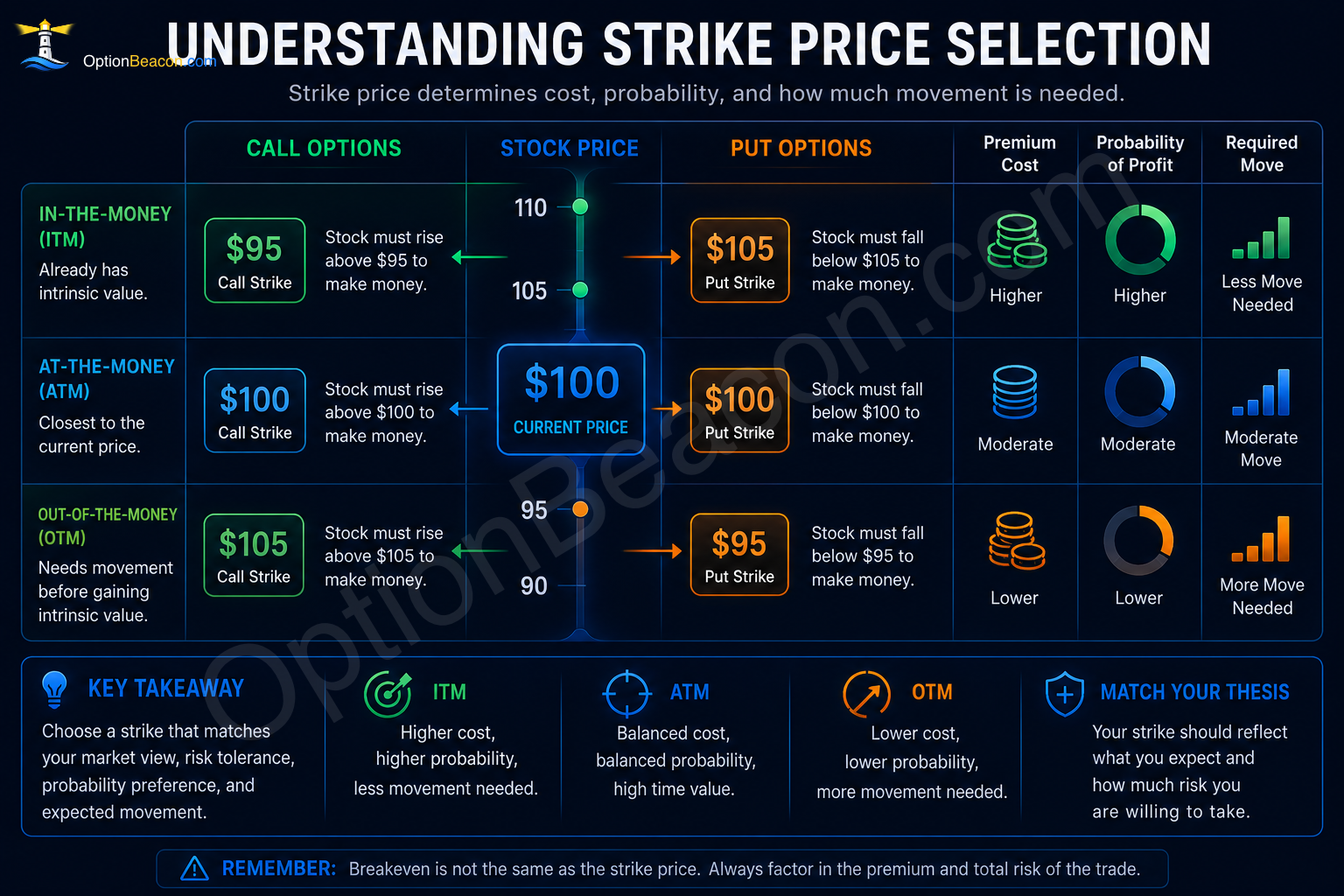
In-The-Money (ITM)
In-the-money options already contain intrinsic value.
Examples:
- Call strike below current stock price.
- Put strike above current stock price.
ITM options typically:
- Cost more.
- Have higher delta.
- React more directly to stock movement.
- Require less movement to gain intrinsic value.
At-The-Money (ATM)
At-the-money options are near the current stock price.
These contracts often contain:
- High extrinsic value.
- Strong gamma exposure.
- Significant time value.
ATM options are commonly used when traders expect movement soon.
Out-Of-The-Money (OTM)
Out-of-the-money options require additional movement before gaining intrinsic value.
OTM contracts typically:
- Cost less.
- Have lower delta.
- Need larger moves.
- Expire worthless more frequently.
Cheap premium does not automatically mean good value.
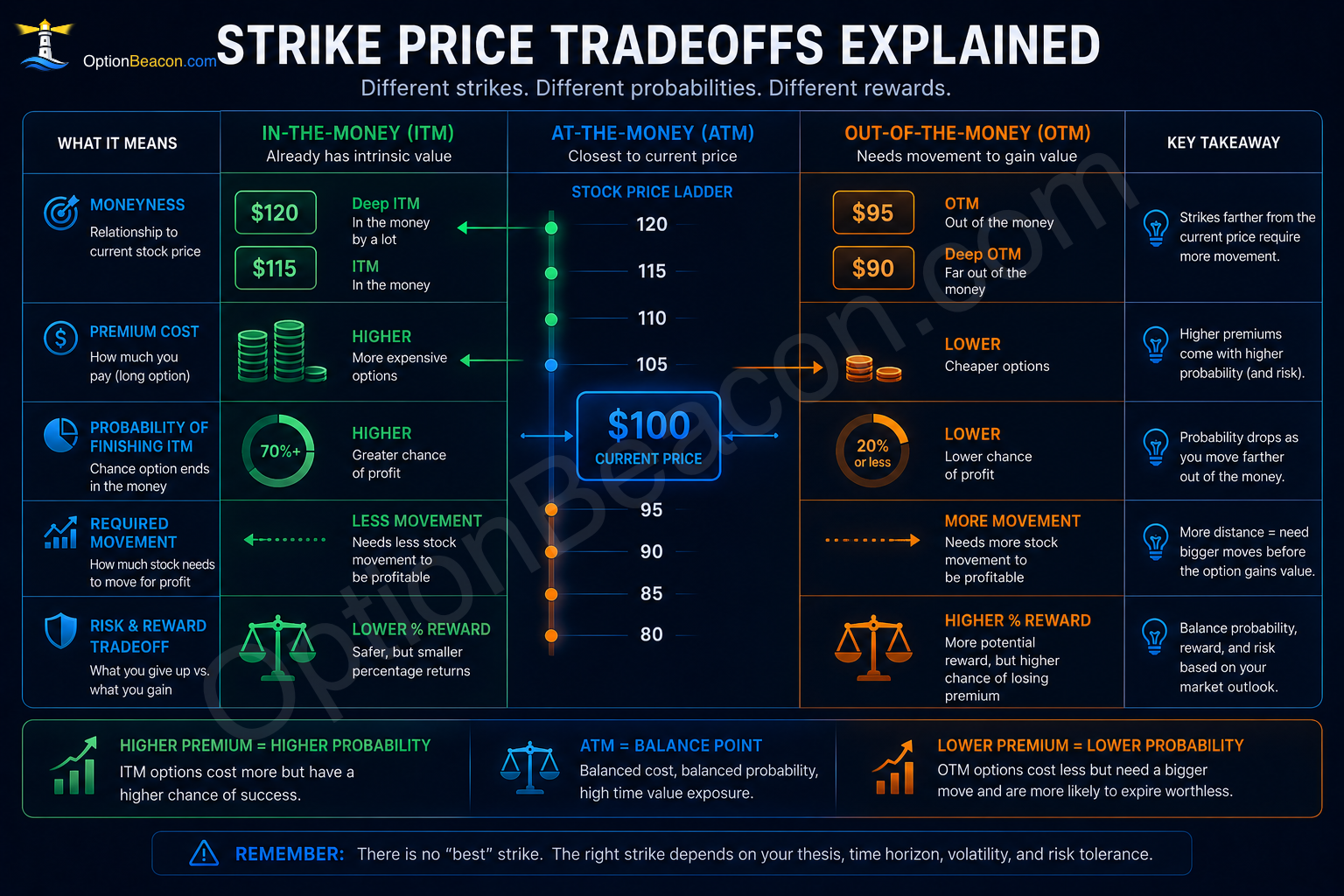
How Strike Price Affects Premium
Strike selection directly affects option pricing.
Generally:
| Strike Type | Typical Premium |
|---|---|
| Deep ITM | Higher premium |
| ATM | Moderate to high premium |
| Far OTM | Lower premium |
More expensive options often carry:
- Higher probability.
- More intrinsic value.
- Higher sensitivity to stock movement.
Cheaper options usually require larger directional moves before becoming profitable.
Probability vs Reward Tradeoff
Strike selection is always a tradeoff.
Higher probability strikes usually:
- Cost more.
- Offer smaller percentage returns.
- Move more like stock.
Lower probability strikes usually:
- Cost less.
- Offer larger theoretical upside.
- Expire worthless more often.
This is one of the most important concepts beginners must understand.
How Strike Price Affects Sellers
Strike selection matters just as much for option sellers.
For short options:
- Strikes closer to current price usually collect more premium.
- Strikes farther away usually reduce premium but may reduce assignment probability.
However:
- Lower premium does not eliminate risk.
A short strike defines where obligation begins.
Real Example
Imagine a stock trading at:
- $100.
A trader considers three put options:
| Strike | Characteristics |
|---|---|
| $105 Put | Already in the money |
| $100 Put | Near current price |
| $95 Put | Out of the money |
Each strike expresses a different assumption.
The $105 put already contains intrinsic value.
The $100 put reflects movement near the current stock price.
The $95 put requires further downside movement before gaining intrinsic value.
Examples are simplified so the mechanics are easier to see. Real trades also include commissions, fees, taxes, changing implied volatility, early assignment risk, and execution quality.
Breakeven Is NOT the Same as Strike Price
Many beginners confuse strike price with breakeven.
They are not the same.
For long options:
- Breakeven = strike price + premium paid for calls.
- Breakeven = strike price - premium paid for puts.
An option can move in the correct direction and still lose money if the move is not large enough.
Strike Price and Delta
Delta changes with strike selection.
Generally:
| Strike Type | Typical Delta Behavior |
|---|---|
| ITM | Higher delta |
| ATM | Moderate delta |
| OTM | Lower delta |
Higher delta options usually:
- Cost more.
- React more strongly to stock movement.
- Behave more similarly to shares.
Lower delta options usually:
- Cost less.
- Require larger movement.
- Are more speculative.
Professional Trader Lens
Professionals choose strikes by matching the trade thesis to risk limits.
They ask:
- What price level invalidates the idea?
- Does the premium justify the obligation?
- Is the probability realistic?
- How much movement is already priced in?
- What happens if volatility changes?
A professional process usually starts with:
- The underlying stock.
- Implied volatility.
- Strategy selection.
- Strike selection.
- Position size.
The option contract is the expression of the idea, not the idea itself.
Risks and Tradeoffs
- Cheap far out-of-the-money options often expire worthless.
- Short strikes too close to spot can create frequent assignment pressure.
- High premium may signal high expected movement.
- Lower delta does not eliminate risk.
- Higher probability trades may still carry large downside exposure.
Risk should be reviewed before entry and again after the trade changes.
Options positions can evolve quickly because delta, gamma, theta, and vega are not static.
A position that looked conservative at entry can become aggressive after a large move or as expiration approaches.
Common Mistakes
Choosing strikes only by premium
Cheap options often require unrealistic movement.
Ignoring support, resistance, and event risk
Strike placement should consider:
- Technical levels.
- Earnings.
- Macro events.
- Volatility.
Forgetting that breakeven is not the same as strike price
The premium paid changes the actual breakeven level.
Assuming lower delta means safe
Lower delta only means lower sensitivity to current movement.
Trading strikes without understanding assignment exposure
Short strikes create obligations that may become very real during volatile markets.
Most beginner mistakes come from focusing on premium instead of total exposure.
Premium is visible immediately, but the obligation, drawdown, opportunity cost, and assignment scenario matter just as much.
Practical Checklist
Before choosing a strike price:
- Can you explain why you selected this strike?
- Do you understand the maximum planned loss?
- Does the strike match your market thesis?
- Have you checked implied volatility and upcoming events?
- Do you understand assignment exposure?
- Does the premium justify the probability and risk?
- Is the position small enough that you can follow your plan?
Which Strike Is Best?
There is no universal best strike price.
The best strike depends on:
- Market outlook.
- Time horizon.
- Implied volatility.
- Risk tolerance.
- Strategy structure.
- Probability preference.
Good strike selection is about balancing:
- Probability.
- Risk.
- Premium.
- Reward.
- Capital exposure.
Related Beginner Guides
Continue learning:
- Understanding Implied Volatility
- Call vs Put Options Explained
- Options Expiration and Time Decay
- Common Options Strategies for Beginners
- Risks of Options Trading
Key Takeaways
- Strike price selection changes risk and reward.
- ITM options cost more but require less movement.
- OTM options cost less but expire worthless more often.
- Breakeven is not the same as strike price.
- Higher premium often reflects higher probability or higher risk.
- Strike selection should match the trade thesis.
- Cheap options are not automatically better opportunities.
FAQ
Is a higher delta safer?
Higher delta may depend less on a large move, but it usually costs more and still carries risk.
Should sellers choose low-delta strikes?
Lower delta may reduce assignment probability, but it also reduces premium and does not eliminate risk.
What is the best strike price?
There is no universal best strike. It depends on thesis, time horizon, implied volatility, risk tolerance, and strategy structure.
Why are some options so cheap?
Far out-of-the-money options often cost less because they require larger movement before gaining intrinsic value.
Why do in-the-money options cost more?
ITM options already contain intrinsic value and usually have higher delta exposure.
Is cheaper premium always better?
No. Cheap premium may reflect low probability or unrealistic required movement.