


Options Strategies
Covered Calls: A Step-by-Step Guide
Learn how covered calls work, when traders use them, and what risks beginners should understand.
Overview
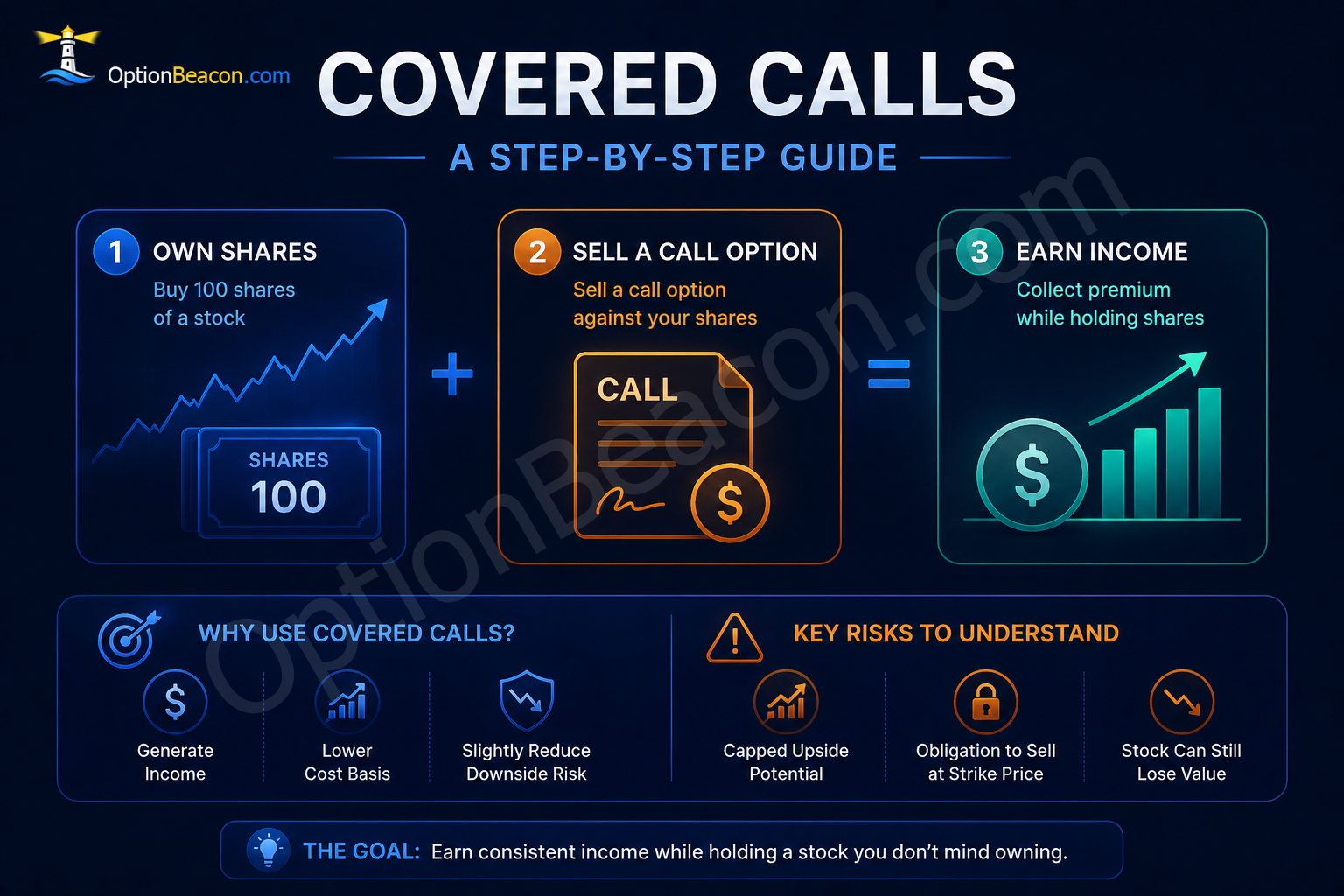
A covered call combines:
- Long stock ownership.
- Selling a call option against the shares.
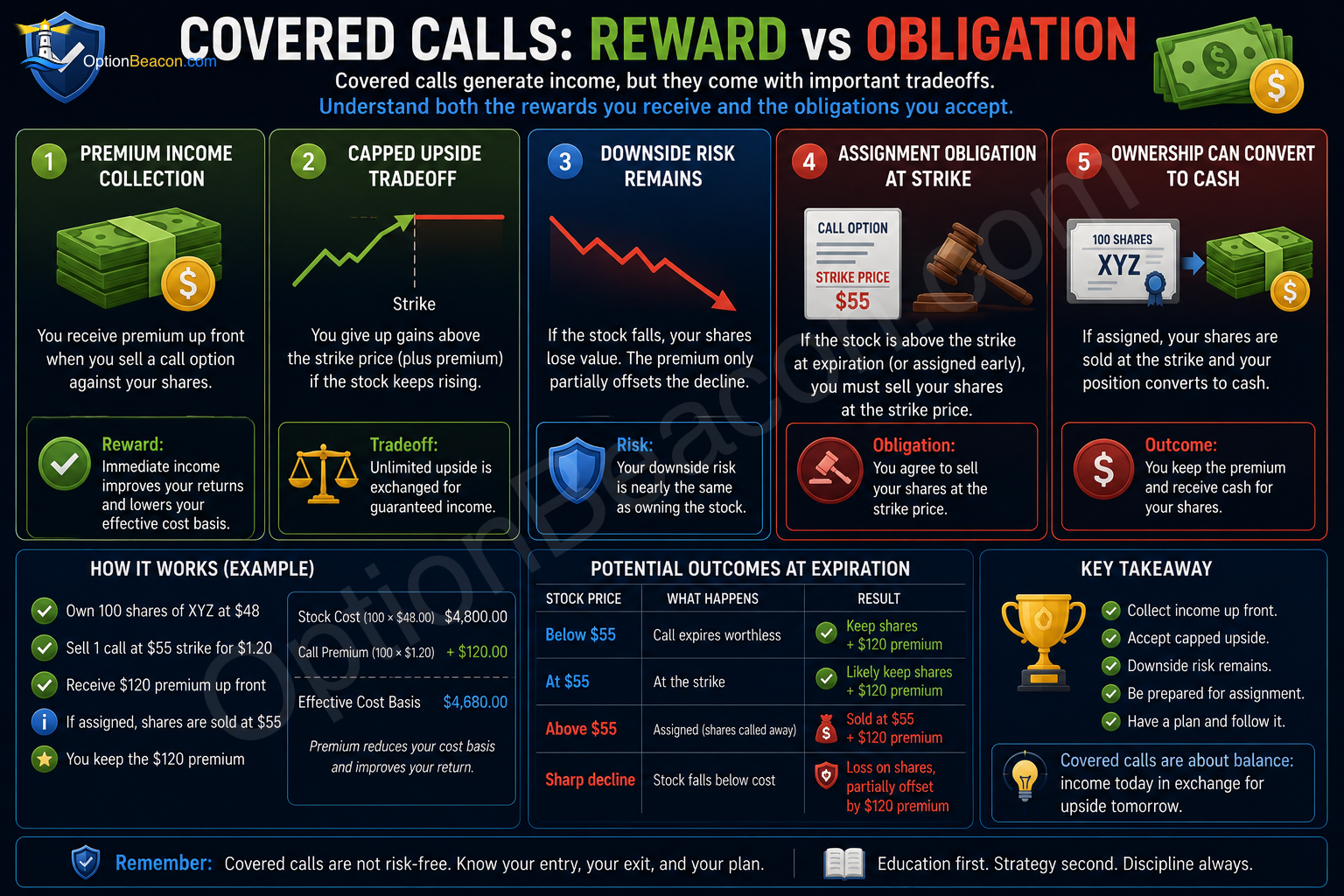
The strategy generates premium income, but the trader gives up part of the upside if the stock rises above the strike price.
Covered calls are often viewed as:
- Income-oriented.
- Moderately bullish.
- Neutral-to-bullish.
- Lower-volatility stock overlays.
But covered calls are not:
- Free income.
The stock still carries downside risk.
If the stock falls sharply, the premium collected may only offset a small portion of the loss.
Covered calls are commonly used by investors who:
- Already own shares.
- Are willing to sell at a target price.
- Want to generate additional income.
- Expect limited upside in the near term.
This guide explains covered calls in practical terms. It is written for education, not as a trade recommendation. Before using any options strategy, understand assignment risk, stock exposure, liquidity, expiration behavior, and tax considerations.
What Is a Covered Call?
A covered call contains two parts:
| Component | Position |
|---|---|
| Stock | Long 100 shares |
| Option | Short 1 call option |
One call contract typically controls:
- 100 shares.
The short call is considered covered because the investor already owns the shares needed if assignment occurs.
Simple Covered Call Logic
The strategy works like this:
1. Own stock. 2. Sell upside beyond a selected strike. 3. Collect premium income.
The trader accepts:
- Capped upside.
- Continued downside stock risk.
- Assignment possibility.
In exchange for premium received up front.
How Covered Calls Work
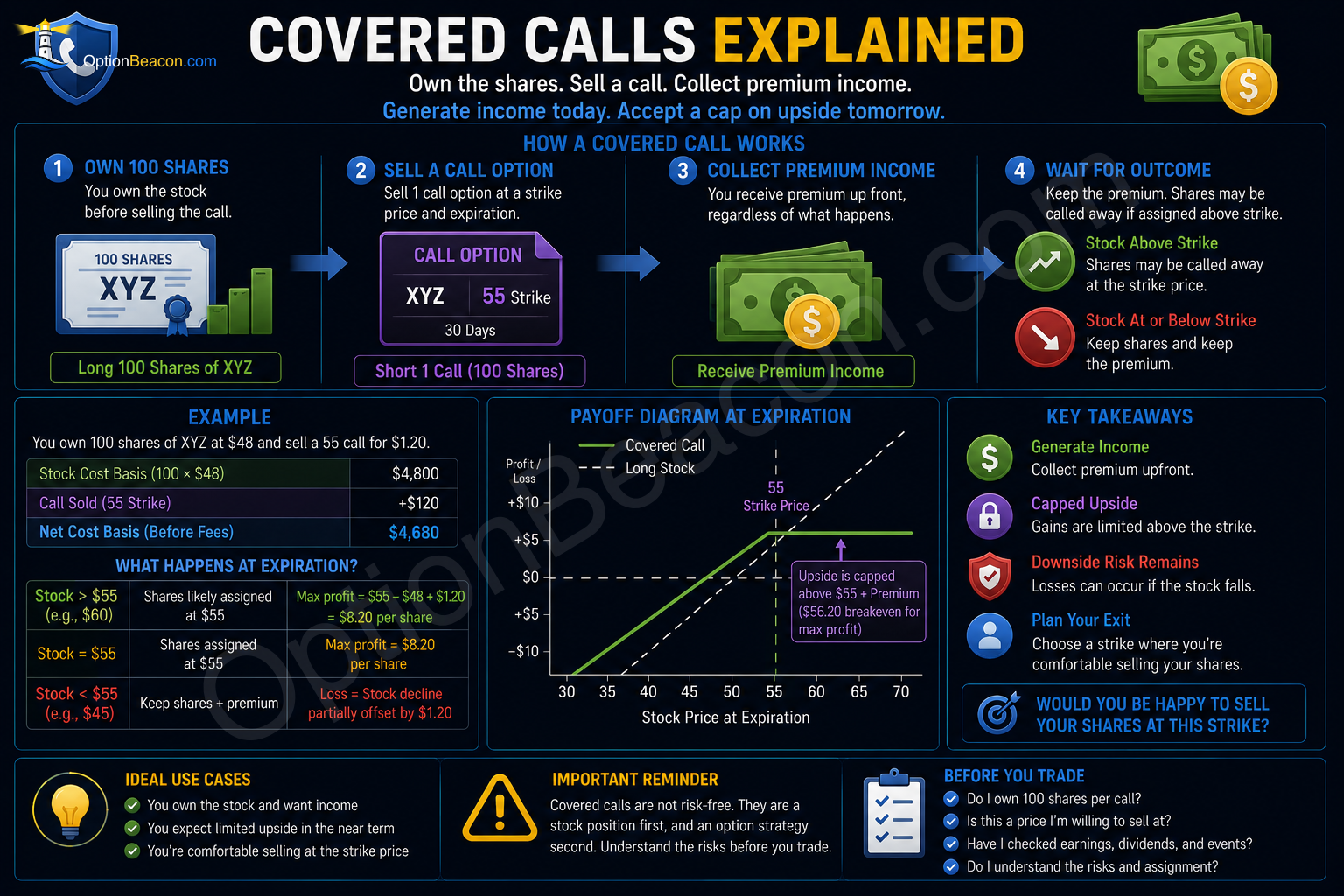
Step 1 — Own the Shares
The investor owns:
- 100 shares per call sold.
Example:
| Position | Quantity |
|---|---|
| Long Stock | 100 shares |
Step 2 — Sell a Call Option
The trader sells a call at a selected:
- Strike price.
- Expiration date.
Example:
- Sell 1x $55 call.
The strike usually represents:
- The price where the investor is willing to sell shares.
Step 3 — Collect Premium
The premium is received immediately.
Example:
- $1.20 premium = $120 before fees.
The premium:
- Lowers effective stock cost basis.
- Provides partial downside cushion.
- Caps future upside potential.
Step 4 — Wait for Expiration or Assignment
Possible outcomes:
| Stock Outcome | Result |
|---|---|
| Stock stays below strike | Keep shares + premium |
| Stock rises above strike | Shares may be called away |
| Stock falls | Stock loses value, partially offset by premium |
Real Example
An investor owns:
- 100 shares at $48.
They sell:
- 1x $55 call for $1.20.
Possible outcomes:
| Stock Price at Expiration | Result |
|---|---|
| Below $55 | Keep shares + $120 premium |
| Above $55 | Shares likely sold at $55 |
| Sharp decline | Premium offsets only part of stock loss |
Maximum upside is generally capped near:
- Strike price + premium received.
Examples are simplified so the mechanics are easier to see. Real trades also include commissions, fees, taxes, changing implied volatility, assignment risk, and execution quality.
Why Traders Use Covered Calls
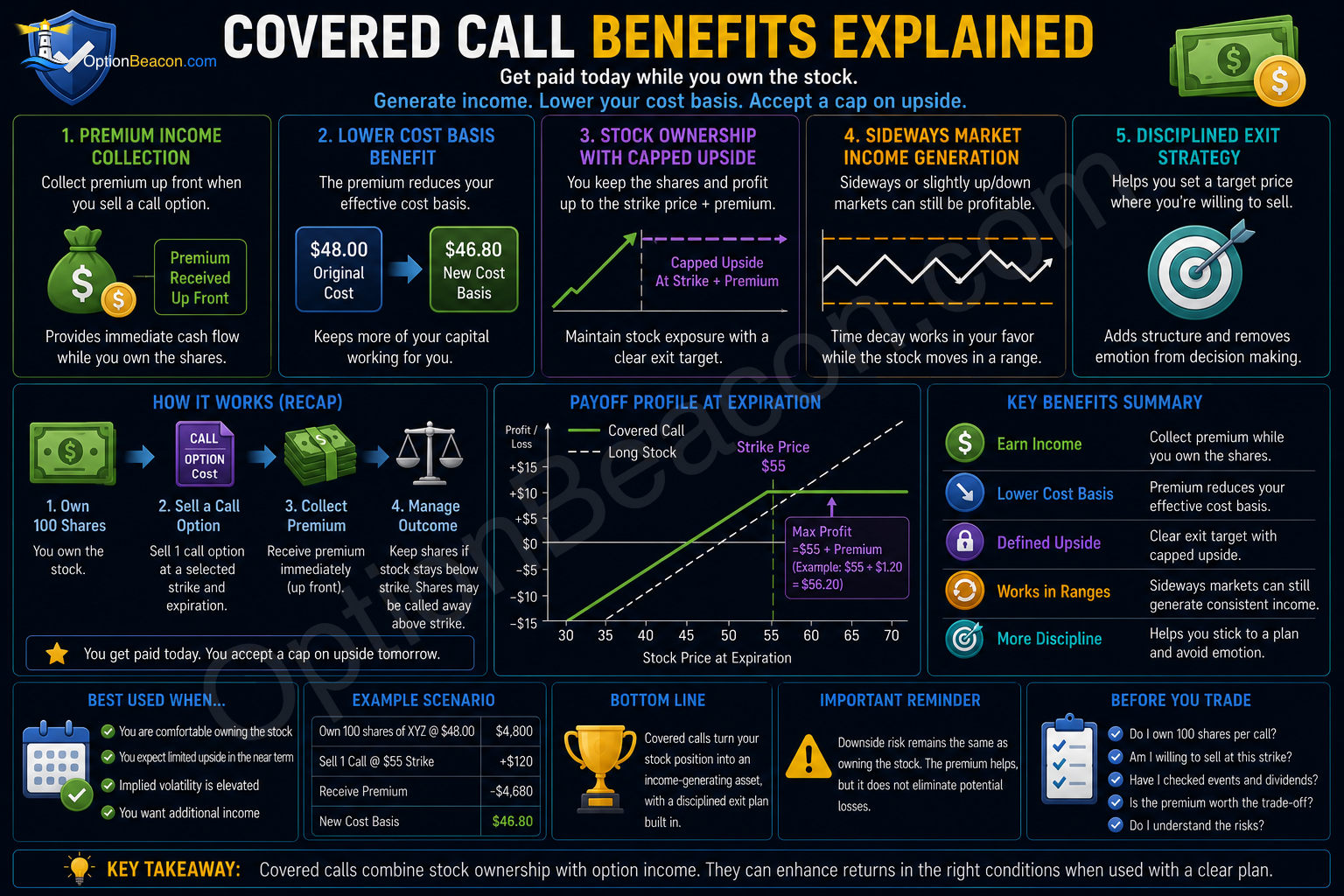
Covered calls are often used to:
- Generate income.
- Reduce cost basis slightly.
- Create disciplined exit targets.
- Enhance returns in sideways markets.
Common situations include:
- Long-term stock ownership.
- Retirement income strategies.
- Range-bound expectations.
- Lower-volatility outlooks.
Understanding the Tradeoff
Covered calls exchange:
- Unlimited upside.
For:
- Immediate premium income.
That tradeoff becomes important during strong rallies.
If the stock surges far above the strike:
- Gains above the strike are forfeited.
- Shares may be called away.
- Opportunity cost may become large.
This is why professionals ask:
- Would I truly be comfortable selling my shares at this strike?
Covered Calls and Assignment
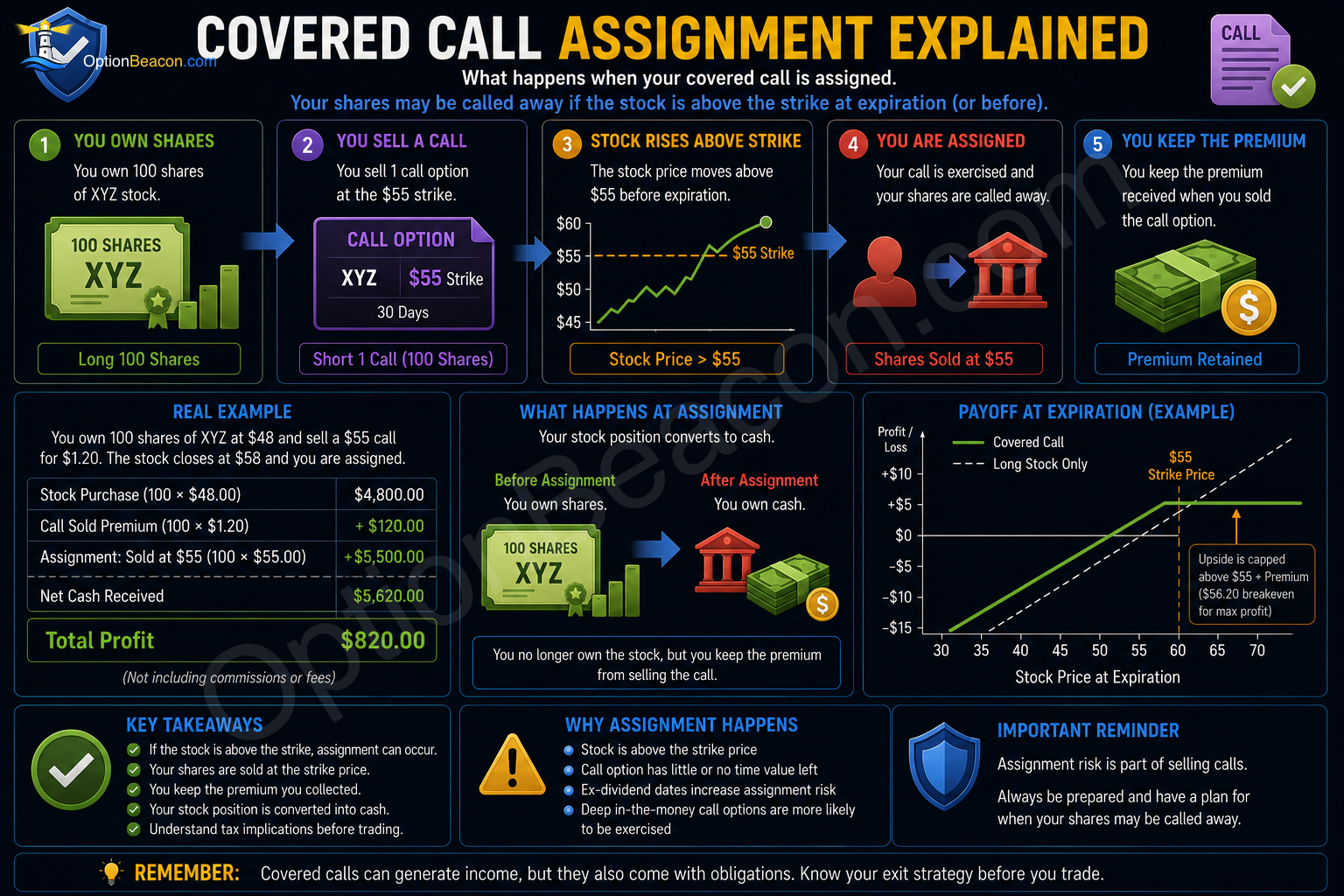
Short calls can be assigned before expiration.
Assignment risk increases when:
- The call becomes deep in the money.
- Expiration approaches.
- Dividends approach.
- Extrinsic value becomes small.
If assigned:
- Shares are sold at the strike price.
This may:
- Trigger taxes.
- Close long-term holdings.
- Alter portfolio exposure.
Strike Selection Matters
Strike selection changes:
- Premium amount.
- Assignment probability.
- Upside potential.
General comparison:
| Strike Type | Characteristics |
|---|---|
| Lower strike | More premium, less upside room |
| Higher strike | Less premium, more upside room |
Choosing strikes only by premium can create poor trades.
High premium often means:
- Higher expected volatility or risk.
Expiration Selection Matters Too
Expiration affects:
- Time decay.
- Premium collected.
- Assignment risk.
- Management frequency.
Shorter expirations may provide:
- Faster theta decay.
- More frequent premium opportunities.
But they also create:
- Higher gamma risk.
- More active management.
Longer expirations may:
- Decay slower.
- Reduce management frequency.
- Tie up shares longer.
Covered Calls and Volatility
Implied volatility strongly affects covered calls.
Higher implied volatility usually means:
- Larger premiums.
- Higher expected movement.
- Higher assignment probability.
Lower implied volatility usually means:
- Smaller premiums.
- Lower expected movement.
Many traders prefer:
- Selling covered calls during elevated IV environments.
But higher premium does not eliminate stock risk.
Professional Trader Lens
Professionals treat covered calls as:
- A stock management overlay.
Not a standalone income machine.
Professional traders focus on:
- Stock quality first.
- Volatility environment.
- Strike placement.
- Tax implications.
- Assignment planning.
- Total portfolio exposure.
A professional process usually starts with:
- Underlying thesis.
- Acceptable exit price.
- Volatility analysis.
- Strike selection.
- Expiration selection.
- Position sizing.
The option contract expresses the idea — not the idea itself.
Risks and Tradeoffs
Stock Downside Risk Remains
Covered calls do not meaningfully protect against large declines.
Upside Is Capped
Strong rallies may create significant opportunity cost.
Assignment Can Occur Early
Especially near dividends or expiration.
Taxes May Become Complicated
Assignment can affect holding periods and realized gains.
Emotional Decision-Making Can Hurt Performance
Many traders become emotionally attached to shares and ignore strike discipline.
Common Mistakes
Selling Calls on Shares You Refuse to Sell
This creates emotional conflict when assignment risk rises.
Chasing High Premiums
High implied volatility may reflect real underlying risk.
Ignoring Earnings Events
Large moves can quickly overpower collected premium.
Ignoring Ex-Dividend Dates
Early assignment risk often rises near dividends.
Overestimating Protection
Premium usually offsets only a small portion of downside risk.
Most beginner mistakes come from focusing on premium instead of total exposure, assignment risk, and opportunity cost.
Covered Calls vs Cash-Secured Puts
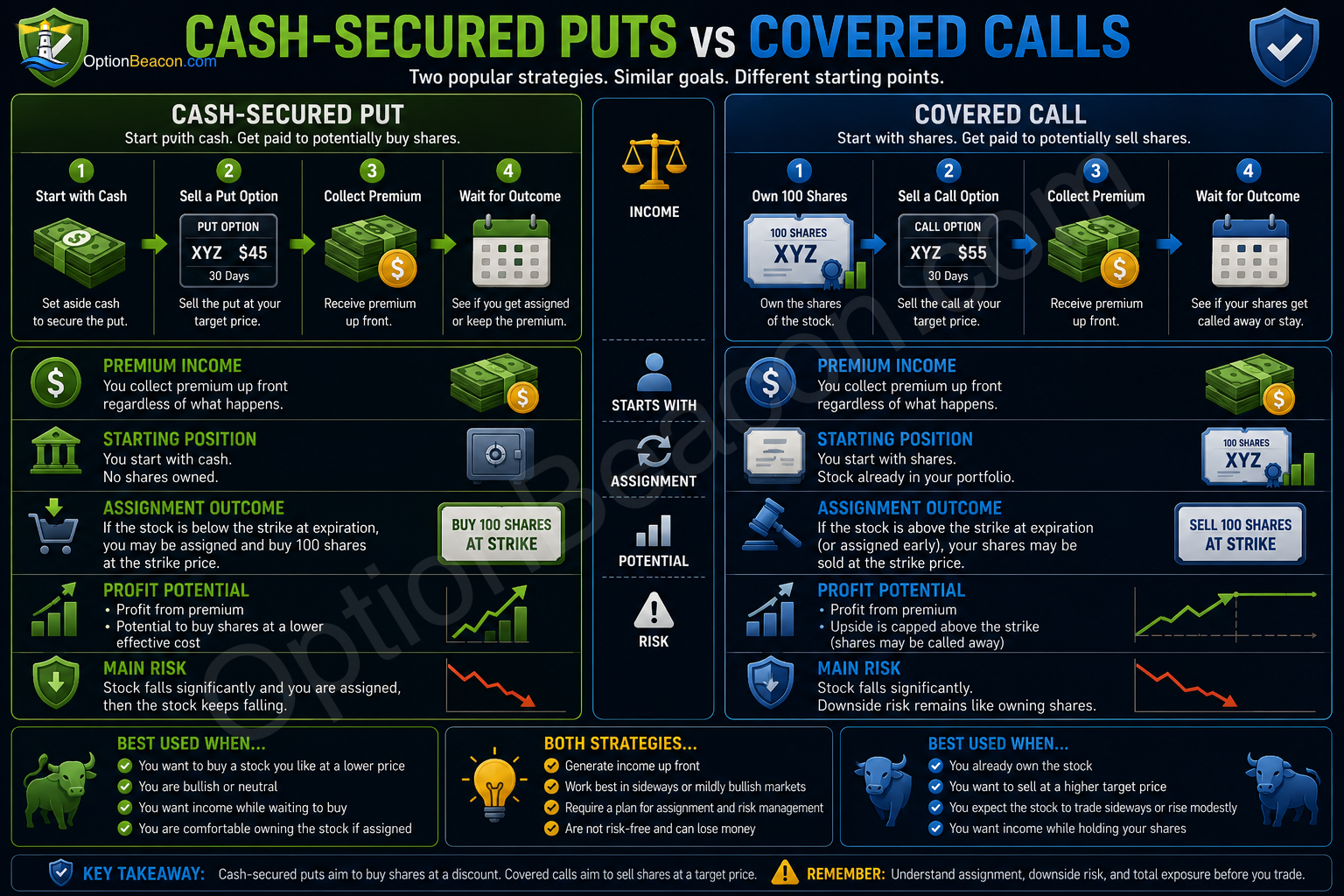
Covered calls and cash-secured puts are often compared because they can produce similar risk/reward profiles.
| Covered Call | Cash-Secured Put |
|---|---|
| Starts with shares | Starts with cash |
| Income from short call | Income from short put |
| Shares can be called away | Shares can be assigned |
| Mild bullish outlook | Mild bullish outlook |
Practical Checklist
Before selling a covered call:
- Am I willing to sell my shares at this strike?
- Is the premium worth capping upside?
- Have I checked earnings and dividend dates?
- Is implied volatility unusually high or low?
- Do I understand assignment risk?
- Is the expiration appropriate for my thesis?
- Is position size reasonable?
Related Guides
Continue learning:
- Cash-Secured Puts Explained
- Rolling an Option: When and Why
- How to Choose the Right Strike Price
- Options Expiration and Time Decay
- Risks of Options Trading
Key Takeaways
- Covered calls combine stock ownership with short calls.
- Premium income comes with capped upside.
- Downside stock risk still remains.
- Assignment may occur before expiration.
- Strike selection affects reward and assignment probability.
- Higher implied volatility usually increases premium.
- Covered calls are stock overlays, not free income.
- Position sizing and planning matter.
FAQ
Can a covered call lose money?
Yes. If the stock falls more than the premium collected, the overall position loses value.
Is covered call income guaranteed?
Premium is received up front, but total profitability is not guaranteed because stock risk remains.
What strike should I use?
Strike selection depends on: - Desired exit price. - Premium goals. - Volatility. - Time frame. - Assignment tolerance.
Can covered calls outperform stocks?
Sometimes in sideways or mildly bullish markets. But during strong rallies, covered calls may underperform because upside is capped.
Can I lose my shares?
Yes. If assigned, the shares are typically sold at the strike price.
Is a covered call conservative?
It is generally considered less aggressive than naked short calls, but it still carries meaningful stock risk. ## Educational Disclaimer OptionBeacon provides educational content only and does not provide financial, investment, or trading advice.