


Options Basics
Common Options Strategies for Beginners
A simple overview of covered calls, cash-secured puts, protective puts, and defined-risk spreads.
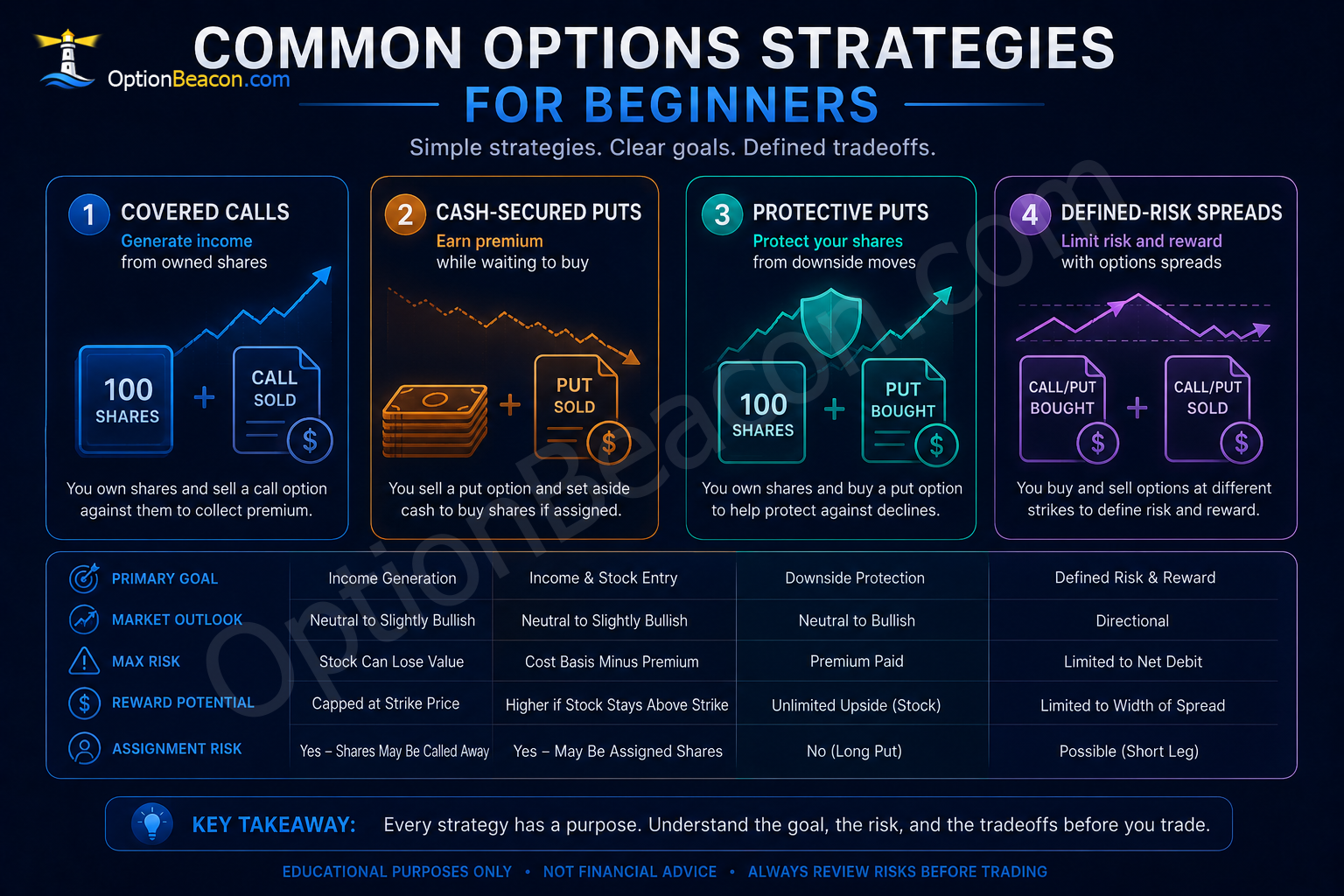
Overview
Options strategies combine contracts, stock, or cash to shape risk and reward. Beginners should start with strategies that are easy to explain and where maximum risk is visible.
This guide explains the idea in practical terms. It is written for education, not as a trade recommendation. Before using any options strategy, understand the contract, the maximum realistic loss, the expiration date, liquidity, and what could happen if the position is assigned or exercised.
Simple Explanation
Options strategies are combinations of:
- Stock ownership.
- Option contracts.
- Cash reserves.
- Defined risk structures.
Different strategies are designed for different market expectations.
Some strategies focus on:
- Generating income.
- Protecting shares.
- Reducing downside exposure.
- Defining maximum risk.
- Creating directional exposure.
The goal is not to find a perfect strategy. The goal is to understand how the structure changes risk, reward, and tradeoffs.
How It Works
- Covered calls combine stock ownership with a short call.
- Cash-secured puts reserve cash for possible assignment.
- Protective puts buy downside protection for stock ownership.
- Vertical spreads define risk by buying and selling options at different strikes.
The important professional habit is to connect the structure to a specific thesis.
A trader should be able to explain:
- What they expect to happen.
- What would prove the idea wrong.
- How much capital is at risk if the market behaves unexpectedly.
The structure should fit the idea, not the other way around.
Covered Calls
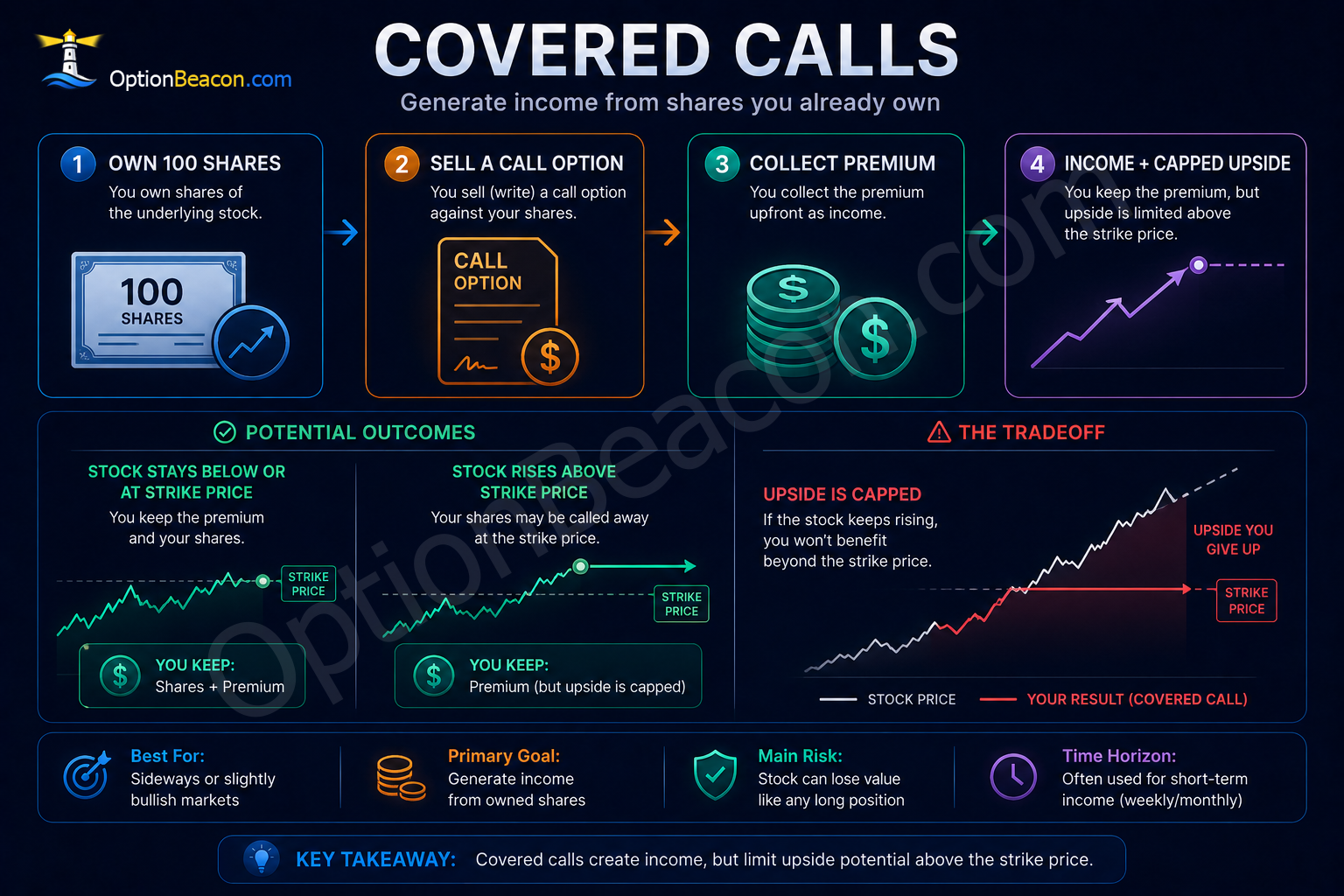
A covered call combines:
- Owning 100 shares.
- Selling one call option against those shares.
Traders often use covered calls to collect option premium while holding stock they already own.
Common Reasons Traders Use Covered Calls
- Generate income from shares.
- Slightly reduce cost basis.
- Earn premium during sideways markets.
- Add structure to long-term holdings.
Important Tradeoff
Covered calls limit upside potential.
If the stock rises above the strike price, shares may be called away through assignment.
Cash-Secured Puts
Cash-secured puts involve:
- Selling a put option.
- Reserving enough cash to buy shares if assigned.
Traders often use this strategy when they are willing to own shares at a lower price.
Common Reasons Traders Use Cash-Secured Puts
- Generate premium income.
- Enter stock positions at lower prices.
- Define capital allocation before assignment.
- Create structured bullish exposure.
Important Tradeoff
If the stock falls sharply, the trader may still be assigned shares at the strike price.
The premium collected does not eliminate downside risk.
Protective Puts
A protective put combines:
- Owning shares.
- Buying a put option for downside protection.
This strategy works similarly to insurance.
Common Reasons Traders Use Protective Puts
- Limit downside risk.
- Protect unrealized gains.
- Reduce emotional decision-making.
- Maintain long-term exposure while controlling risk.
Important Tradeoff
Protective puts cost money.
If the stock does not decline, the put option may expire worthless.
Defined-Risk Spreads
Vertical spreads combine:
- Buying one option.
- Selling another option at a different strike.
These spreads define both:
- Maximum profit.
- Maximum loss.
Common Reasons Traders Use Spreads
- Reduce premium cost.
- Define risk before entry.
- Create directional exposure with smaller capital.
- Structure trades around probability and risk limits.
Important Tradeoff
Defined-risk spreads still carry meaningful risk.
A spread can lose most or all of the planned risk if the market moves against the position.
Real Example
An investor who owns 100 shares may sell one covered call.
The premium creates income, but the investor may have to sell the shares at the strike price if assigned.
Another trader may sell a cash-secured put to potentially buy shares at a lower price while collecting premium.
Examples are simplified so the mechanics are easier to see. Real trades also include commissions, fees, taxes, changing implied volatility, early assignment risk, and execution quality.
Professional Trader Lens
The best beginner strategy is not the one with the highest premium.
It is the strategy where the trader can clearly explain:
- The market assumption.
- Maximum risk.
- Maximum reward.
- Assignment scenario.
- Exit plan.
A professional process usually starts with:
- The underlying stock.
- Implied volatility.
- Strategy selection.
- Position size.
The option contract is the expression of the idea, not the idea itself.
Risks and Tradeoffs
- Covered calls still carry stock downside risk.
- Cash-secured puts can result in owning shares during a decline.
- Protective puts require paying premium for protection.
- Spreads can still lose most or all of the planned risk.
- Assignment risk exists in many multi-leg strategies.
Risk should be reviewed before entry and again after the trade changes.
Options positions can evolve quickly because delta, gamma, theta, and vega are not static.
A position that looked conservative at entry can become aggressive after a large move or as expiration approaches.
Common Mistakes
Choosing strategies by premium alone
Higher premium often means higher risk or higher uncertainty.
Trading multi-leg positions without understanding assignment
Assignment mechanics can change the trade structure quickly.
Using too many contracts too early
Beginners should first understand one-contract outcomes before scaling size.
Ignoring liquidity
Wide bid-ask spreads can significantly affect execution quality and trade outcomes.
Trading strategies without understanding the thesis
Every strategy should match a specific market assumption.
Most beginner mistakes come from focusing on premium instead of total exposure.
Premium is visible immediately, but the obligation, drawdown, opportunity cost, and assignment scenario matter just as much.
Practical Checklist
Before entering an options strategy:
- Can you explain the strategy without looking at the order ticket?
- Do you know the maximum planned loss and realistic worst-case scenario?
- Have you checked bid-ask spread, open interest, and upcoming events?
- Do you know what will happen if assignment occurs?
- Do you know how implied volatility may affect the trade?
- Is the position small enough that you can follow your plan emotionally and financially?
Which Beginner Strategy Is Best?
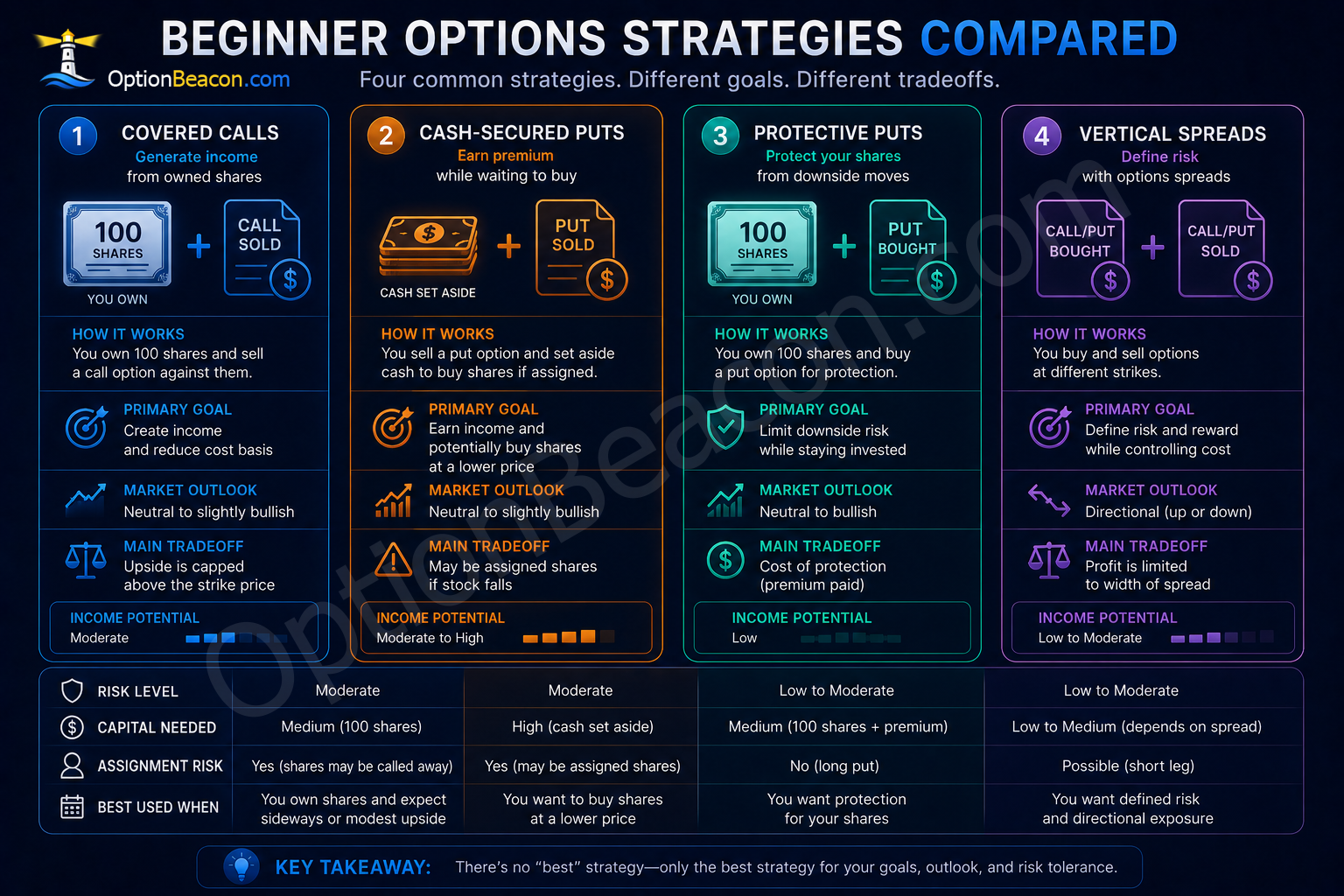
There is no universally best beginner strategy.
Different strategies fit different situations.
| Strategy | Common Goal |
|---|---|
| Covered Calls | Generate income |
| Cash-Secured Puts | Enter shares at lower prices |
| Protective Puts | Protect owned shares |
| Vertical Spreads | Define risk and reduce cost |
The best beginner strategy is usually the one that:
- Is easy to explain.
- Has visible maximum risk.
- Fits the trader's market assumption.
- Matches the trader's experience level.
Related Beginner Guides
Continue learning:
- Covered Calls: A Step-by-Step Guide
- Cash-Secured Puts Explained
- Understanding Implied Volatility
- Options Expiration and Time Decay
- Risks of Options Trading
Key Takeaways
- Options strategies shape risk and reward differently.
- Covered calls focus on income generation.
- Cash-secured puts prepare for possible stock ownership.
- Protective puts provide downside protection.
- Spreads define both maximum risk and maximum reward.
- Simpler strategies can still lose money.
- Strategy selection should match the market thesis.
FAQ
What is the easiest strategy to understand?
Covered calls are often easiest because they connect directly to stock ownership.
Are beginner strategies risk-free?
No. Simpler strategies may still lose money and require risk management.
Should I learn spreads early?
Study spreads early, but trade only after understanding maximum loss, breakeven points, assignment mechanics, and expiration risk.
Which strategy is best for generating income?
Covered calls and cash-secured puts are commonly used for premium income strategies.
Which strategy limits downside risk?
Protective puts are specifically designed to provide downside protection for owned shares.
Do defined-risk spreads eliminate risk?
No. Defined-risk spreads limit risk, but traders can still lose the entire planned risk amount.