


Options Strategies
Cash-Secured Puts Explained
Learn how cash-secured puts work, how assignment can happen, and why cash reserves matter.
Overview
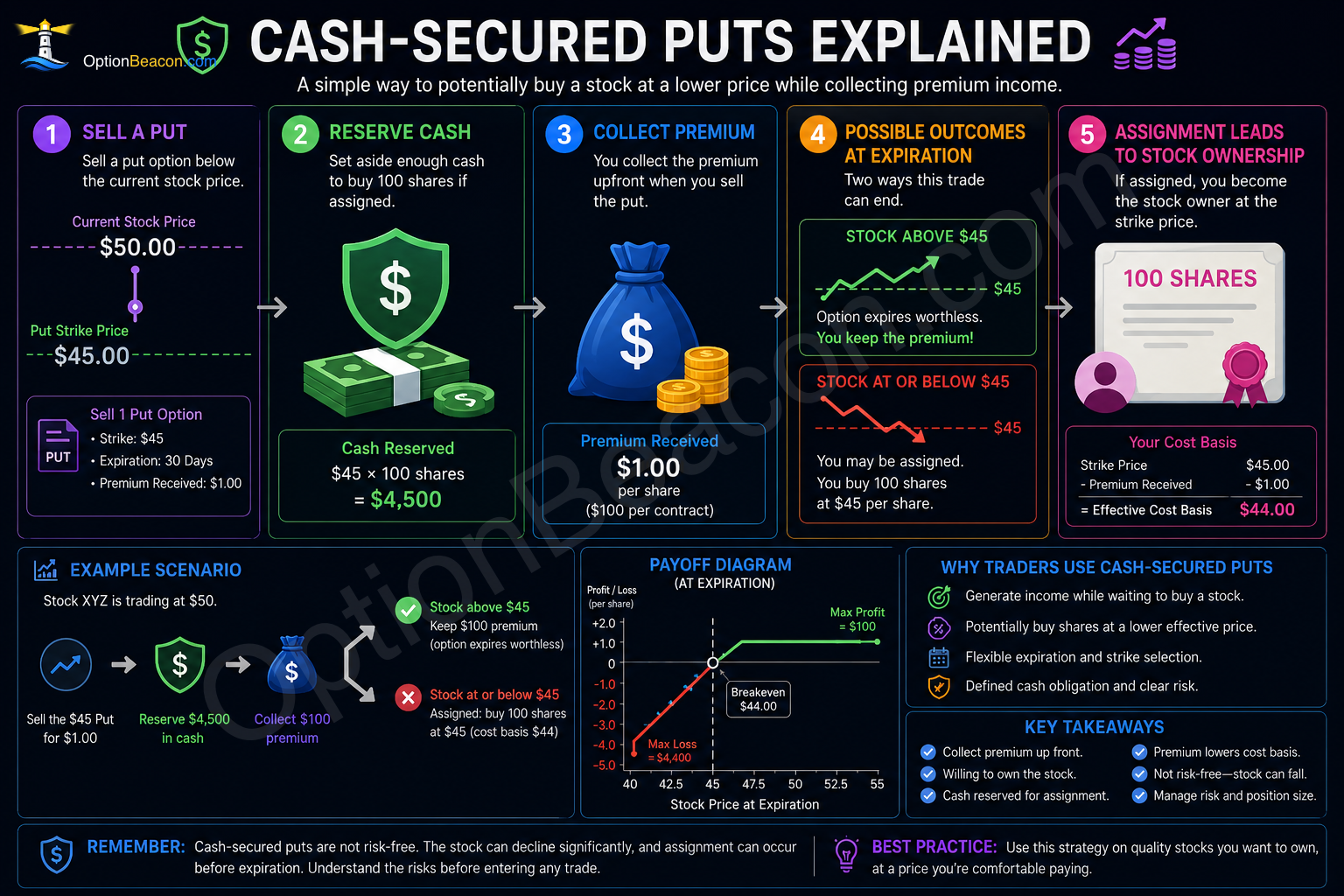
A cash-secured put is an options strategy where a trader sells a put option while reserving enough cash to buy shares if assignment occurs.
The strategy is commonly used by investors who:
- Would not mind owning the stock.
- Want to potentially buy shares at a lower price.
- Want to generate premium income while waiting.
Cash-secured puts are often viewed as a more conservative short put structure because the required purchase cash is already reserved.
However:
- Cash-secured does not mean risk-free.
If the stock falls significantly, the assigned shares can still lose substantial value.
This guide explains the idea in practical terms. It is written for education, not as a trade recommendation. Before using any options strategy, understand the contract, the maximum realistic loss, the expiration date, liquidity, and what could happen if the position is assigned or exercised.
Simple Explanation
A cash-secured put works like this:
1. Choose a stock you are willing to own. 2. Sell a put option below the current stock price. 3. Collect premium immediately. 4. Reserve enough cash to buy 100 shares if assigned.
If the stock stays above the strike price:
- The option may expire worthless.
- The trader keeps the premium.
If the stock falls below the strike:
- Assignment may occur.
- The trader may be required to buy shares at the strike price.
How Cash-Secured Puts Work
Step 1 — Choose a Stock
Most traders use cash-secured puts only on stocks they are comfortable owning.
This is important because assignment is possible.
Professionals often ask:
- If assignment happens tomorrow, would I still want to own this stock?
Step 2 — Select a Strike Price
The strike determines:
- Assignment price.
- Premium collected.
- Probability of assignment.
- Downside exposure.
Lower strikes usually:
- Collect less premium.
- Have lower assignment probability.
Higher strikes usually:
- Collect more premium.
- Carry more risk.
Step 3 — Reserve the Cash
The account reserves enough cash to purchase shares if assigned.
Example:
- $40 strike × 100 shares = $4,000 cash reserved.
This is where the cash-secured name comes from.
Step 4 — Collect Premium
The premium is received when the put is sold.
That premium reduces the effective purchase price if assignment occurs.
Understanding Assignment
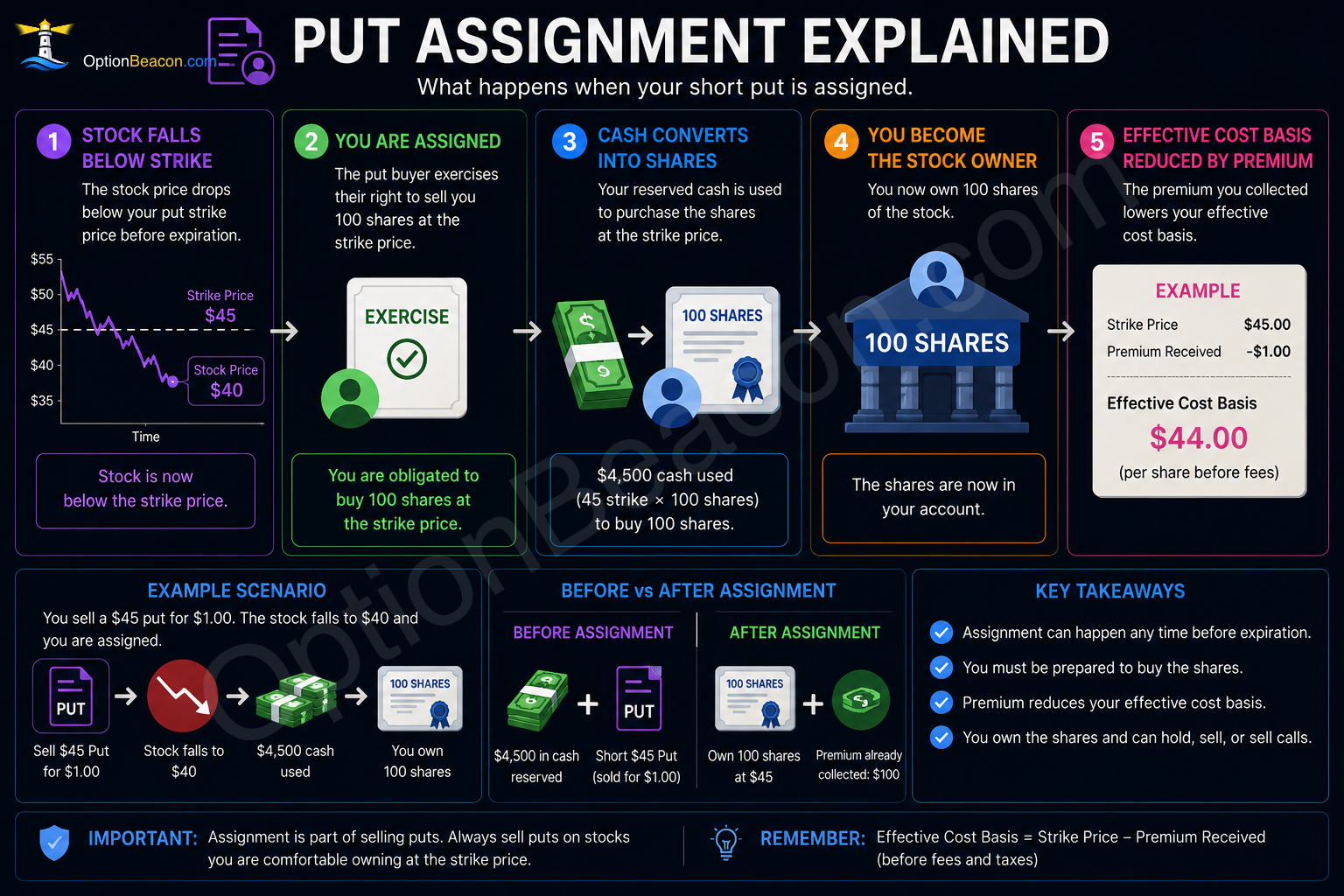
Assignment means the trader must purchase shares at the strike price.
This can happen:
- At expiration.
- Before expiration for American-style options.
- Especially if the put is deep ITM.
Effective Cost Basis
One reason investors use cash-secured puts is to potentially enter stock positions at a lower effective price.
Example
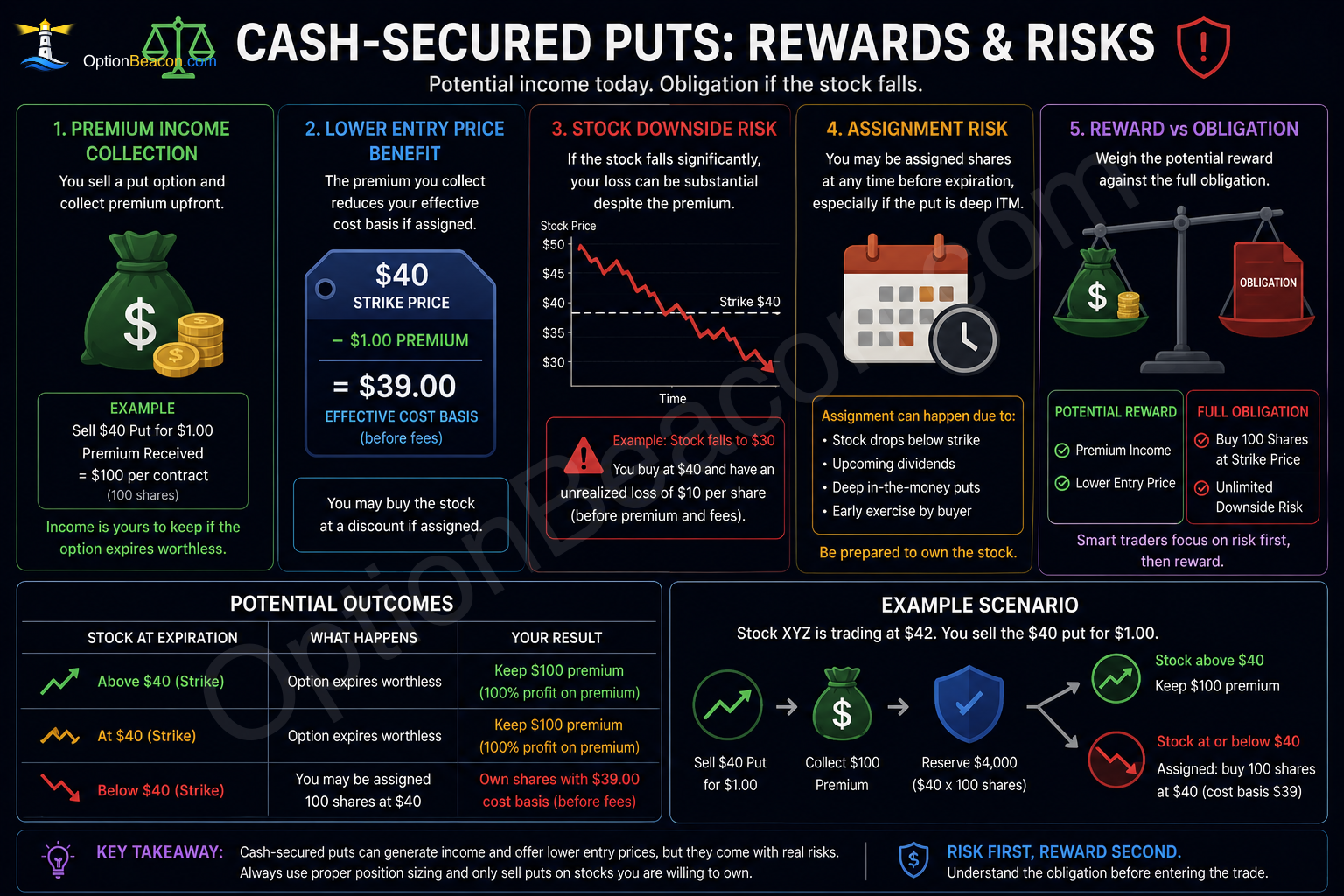
A stock trades at:
- $42.
A trader sells:
- $40 put for $1.00 premium.
Cash reserved:
- $4,000.
If assigned:
- Shares purchased at $40.
- $1 premium already collected.
Effective cost basis:
- $39 per share before fees and taxes.
Why Traders Use Cash-Secured Puts
Cash-secured puts are often used for:
- Entering stocks at lower prices.
- Generating premium income.
- Building long-term positions.
- Income-focused strategies.
- Wheel strategy setups.
Potential Advantages
Premium income
The trader receives premium immediately.
Lower effective entry price
Premium collected may reduce the cost basis if assigned.
Flexible strike selection
Traders can choose strikes that match their market outlook.
Defined cash planning
Because the cash is reserved in advance, the maximum purchase obligation is visible.
Risks and Tradeoffs
Cash-secured puts still carry substantial risk.
Stock downside risk
The largest risk is the stock falling significantly after assignment.
Premium only offsets a small portion of a major decline.
Assignment risk
Assignment may happen unexpectedly.
Especially:
- Near expiration.
- During large declines.
- Around dividends.
- During volatile markets.
Opportunity cost
Reserved cash cannot be used elsewhere while the trade remains open.
Premium temptation
High premiums often exist because:
- Volatility is elevated.
- Uncertainty is elevated.
- Risk is elevated.
Higher premium does not automatically mean safer income.
Real Example
A stock trades at:
- $42.
A trader sells:
- 1 $40 put for $1.00.
Possible outcomes:
| Outcome | Result |
|---|---|
| Stock stays above $40 | Option expires worthless, trader keeps premium |
| Stock falls below $40 | Shares may be assigned |
| Stock collapses to $30 | Trader still buys at $40, creating unrealized loss |
Examples are simplified so the mechanics are easier to see. Real trades also include commissions, fees, taxes, changing implied volatility, early assignment risk, and execution quality.
Professional Trader Lens
Professionals usually sell cash-secured puts only on:
- Liquid stocks.
- Quality companies.
- Position sizes they can comfortably carry.
Professional traders often focus more on underlying quality and risk exposure than on premium size alone.
They also evaluate:
- Implied volatility.
- Earnings dates.
- Sector risk.
- Correlation.
- Portfolio concentration.
A professional process usually starts with:
- The underlying stock.
- Volatility.
- Strike selection.
- Expiration selection.
- Position size.
The option contract is the expression of the idea, not the idea itself.
Common Mistakes
Selling puts on stocks you do not want to own
Assignment risk is real.
Chasing extremely high premium
High premium often signals:
- Elevated volatility.
- Elevated uncertainty.
- Elevated downside risk.
Failing to reserve cash mentally
Even if the broker reserves cash mechanically, traders should still understand the real capital exposure.
Selling too many contracts
Large positions can become dangerous during sharp declines.
Ignoring earnings risk
Short puts before earnings can experience:
- Rapid price movement.
- Volatility spikes.
- Unexpected assignment pressure.
Most beginner mistakes come from focusing on premium instead of total exposure.
Premium is visible immediately, but the obligation, drawdown, opportunity cost, and assignment scenario matter just as much.
Cash-Secured Puts vs Covered Calls
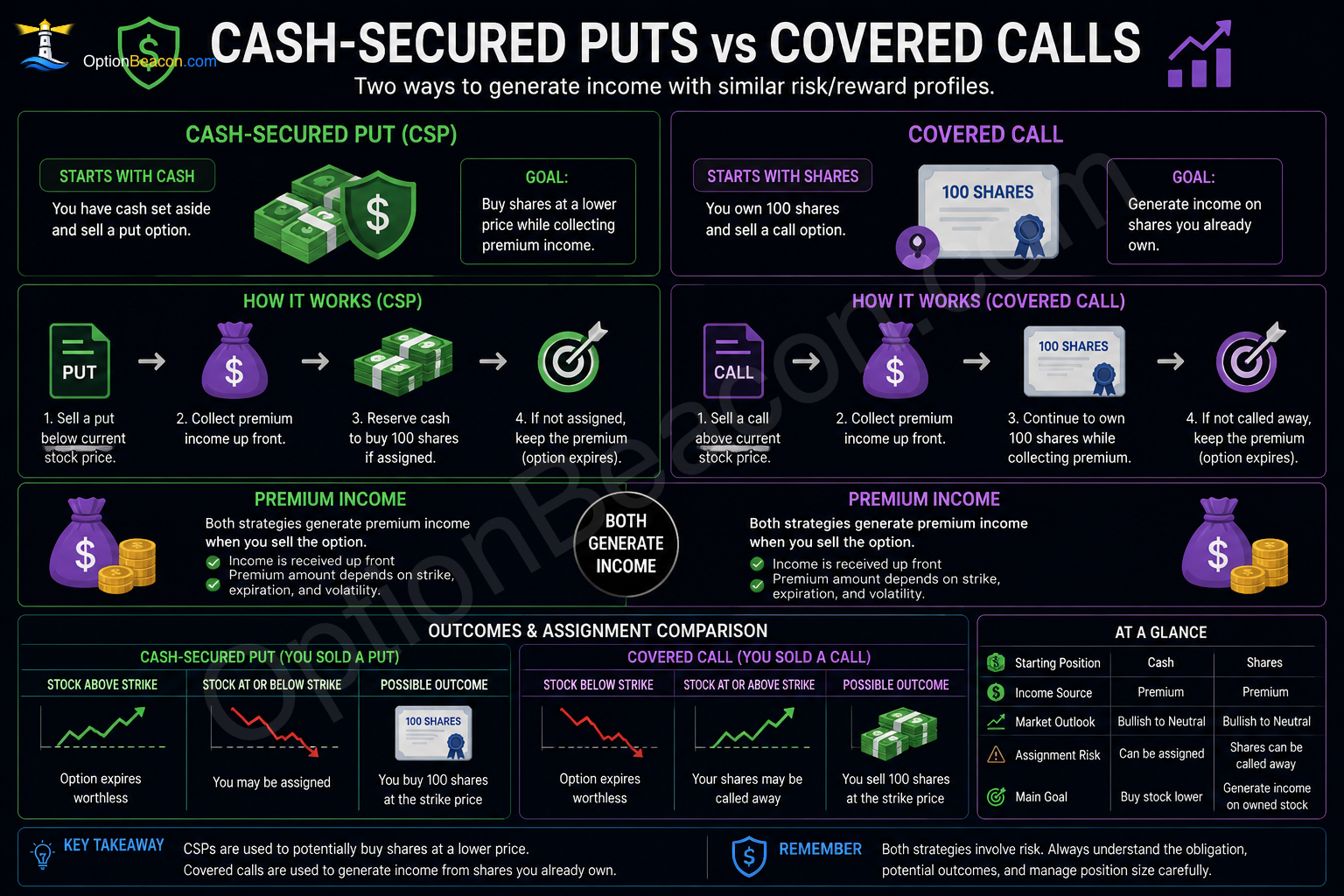
These strategies are often compared because they can create similar risk profiles.
| Cash-Secured Put | Covered Call |
|---|---|
| Starts with cash | Starts with shares |
| Goal: acquire shares lower | Goal: generate income from owned shares |
| Bullish to neutral | Bullish to neutral |
| Assignment creates stock ownership | Assignment sells stock away |
Practical Checklist
Before selling a cash-secured put:
- Would you genuinely want to own the stock?
- Is the strike acceptable?
- Is implied volatility elevated?
- Are earnings approaching?
- Is liquidity sufficient?
- Do you understand assignment mechanics?
- Is the position size appropriate?
- Are you comfortable tying up the reserved cash?
Related Beginner Guides
Continue learning:
- Covered Calls Explained
- How to Choose the Right Strike Price
- Understanding Implied Volatility
- Options Expiration and Time Decay
- Common Options Strategies for Beginners
Key Takeaways
- Cash-secured puts reserve cash for assignment.
- Premium is collected upfront.
- Assignment can create stock ownership.
- Effective cost basis is reduced by premium.
- High premium usually means higher risk.
- Cash-secured does not mean risk-free.
- Position sizing and stock quality matter.
FAQ
Is a cash-secured put risk-free?
No. The reserved cash covers assignment, but the assigned stock can still lose significant value.
Is this strategy bullish?
Generally, cash-secured puts are neutral to bullish. The trader usually wants the stock to remain stable or rise.
What is effective cost basis?
Strike price minus premium received, before fees and taxes.
Can assignment happen early?
Yes. American-style options may be assigned before expiration.
Why do traders use cash-secured puts instead of limit orders?
Some investors prefer collecting premium while waiting for a possible stock entry.
What happens if the stock crashes?
The trader may still be required to buy shares at the strike price, even if the market price falls much lower.