


Options Strategies
Butterfly Spreads Explained
Learn how butterfly spreads combine multiple option legs to create a limited-risk, range-focused payoff.
Overview
A butterfly spread is a multi-leg options strategy designed to profit when the underlying stock finishes near a specific price area at expiration.
Traditional butterflies are:
- Defined-risk.
- Limited-reward.
- Neutral to mildly directional.
- Range-focused.
Butterflies are often used when traders believe:
- The stock may stay near a target price.
Unlike aggressive directional trades, butterflies typically benefit from:
- Controlled movement.
- Stable price action.
- Time decay on short legs.
- Volatility contraction in some cases.
A butterfly spread is not:
- A strategy designed for huge moves.
Large price swings can quickly damage the position.
This guide explains butterfly spreads in practical terms. It is written for education, not as a trade recommendation. Before using any options strategy, understand assignment risk, expiration behavior, liquidity, commissions, and how multi-leg positions behave near expiration.
What Is a Butterfly Spread?
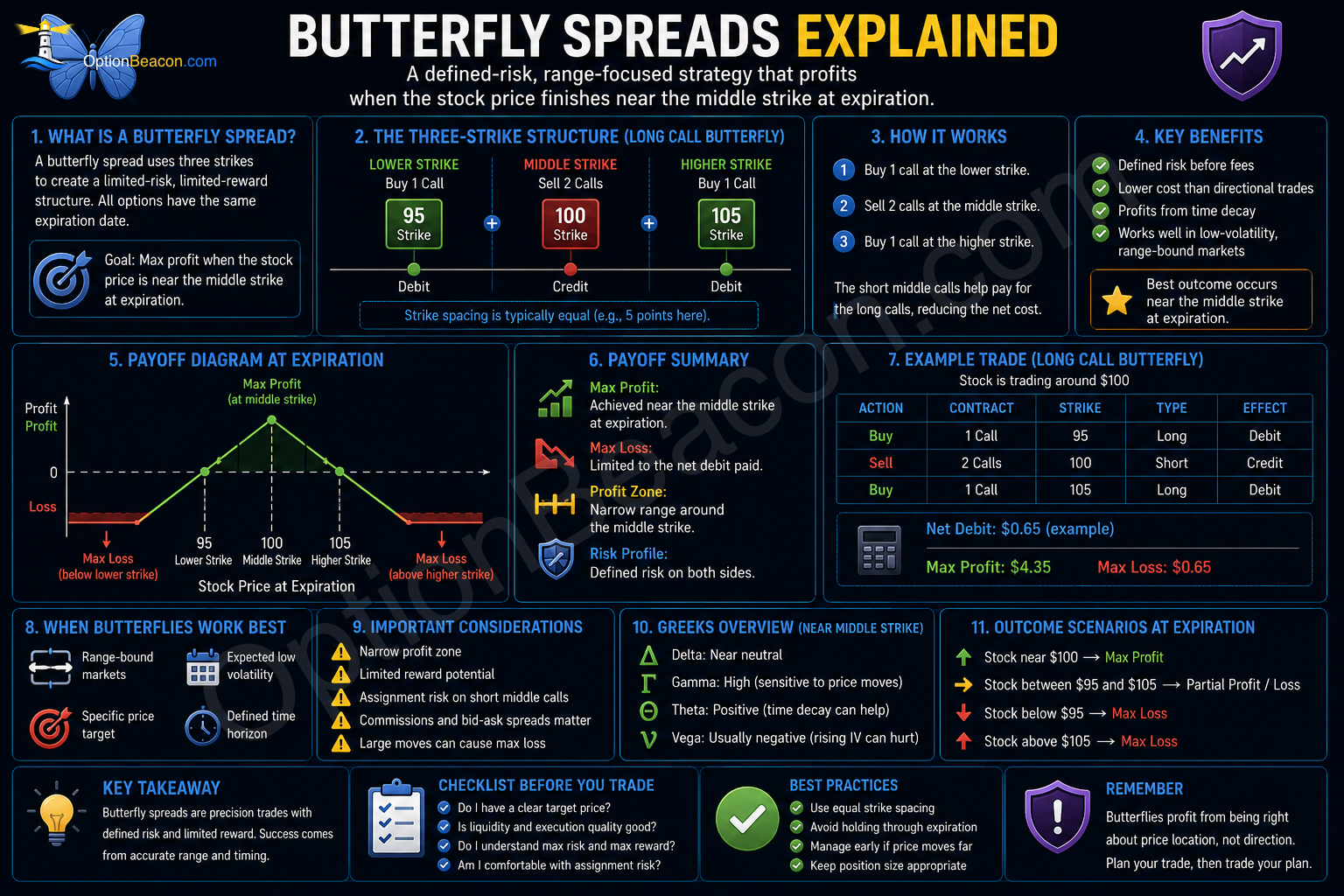
A standard long call butterfly usually contains:
- 1 long lower-strike call.
- 2 short middle-strike calls.
- 1 long higher-strike call.
All contracts typically share:
- The same expiration date.
- Equal strike spacing.
Example:
| Leg | Strike |
|---|---|
| Buy 1 Call | $95 |
| Sell 2 Calls | $100 |
| Buy 1 Call | $105 |
The middle strike:
- Is usually the target price area.
Simple Butterfly Logic
A butterfly combines:
- A bullish vertical spread.
- A bearish vertical spread.
Together, they create:
- Capped profit.
- Capped risk.
- Narrow optimal range.
The ideal outcome usually occurs when:
- The stock finishes near the middle strike at expiration.
How Butterfly Spreads Work
Step 1 — Buy the Lower Strike
This creates bullish exposure.
Example:
- Buy 95 call.
Step 2 — Sell Two Middle Strikes
These short contracts help finance the trade.
Example:
- Sell 2x 100 calls.
The middle strike becomes:
- The peak profit area.
- The target zone.
Step 3 — Buy the Higher Strike
This caps upside risk.
Example:
- Buy 105 call.
Now total risk becomes defined.
Why Traders Use Butterfly Spreads
Butterflies are often used when traders expect:
- Limited movement.
- Price stabilization.
- Expiration pinning.
- Lower realized volatility.
Common situations include:
- Post-earnings stabilization.
- Slow-moving stocks.
- Neutral outlooks.
- Range-bound markets.
Understanding the Payoff Shape
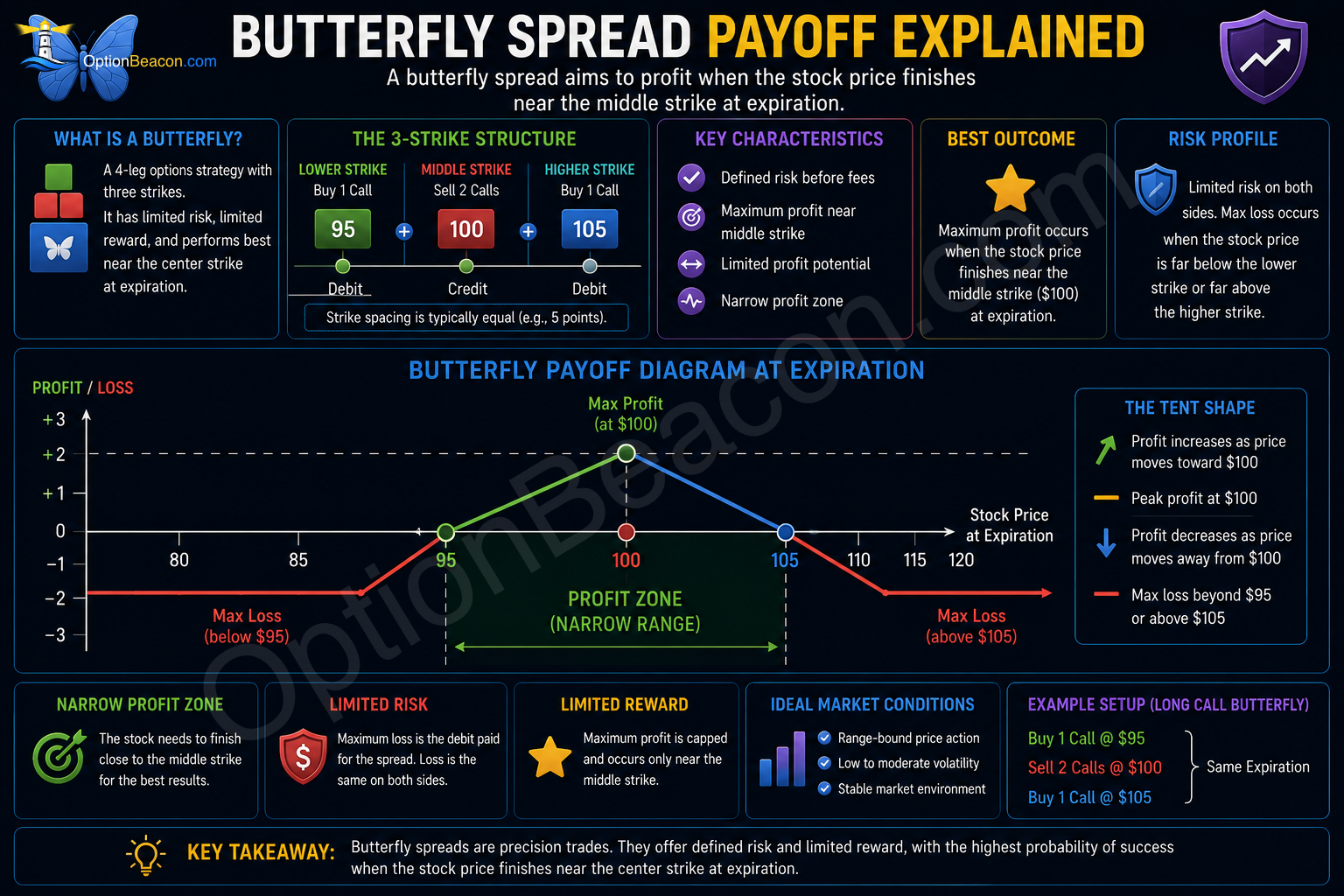
Butterflies usually create:
- Small max risk.
- Narrow max profit zone.
- Limited upside.
- Limited downside.
The payoff graph often looks like:
- A tent or mountain shape.
Maximum profit is often achieved near the middle strike at expiration.
Real Example
A stock trades near:
- $100.
A trader builds:
| Action | Strike |
|---|---|
| Buy 1 Call | $95 |
| Sell 2 Calls | $100 |
| Buy 1 Call | $105 |
Possible outcomes:
| Stock Price at Expiration | Outcome |
|---|---|
| Near $100 | Best result |
| Far below $95 | Max loss zone |
| Far above $105 | Max loss zone |
| Between strikes | Partial profit/loss |
Examples are simplified so the mechanics are easier to see. Real trades also include commissions, fees, taxes, assignment risk, volatility changes, and execution quality.
Why Butterflies Can Be Attractive
Defined Risk
Maximum theoretical loss is usually known before entry.
Lower Cost Than Naked Directional Trades
Short middle strikes help reduce entry cost.
Efficient for Neutral Views
Butterflies may work well when traders do not expect major movement.
Time Decay Can Help
As expiration approaches:
- Short middle strikes decay.
- The structure may become more sensitive near the target zone.
But Butterflies Have Important Tradeoffs
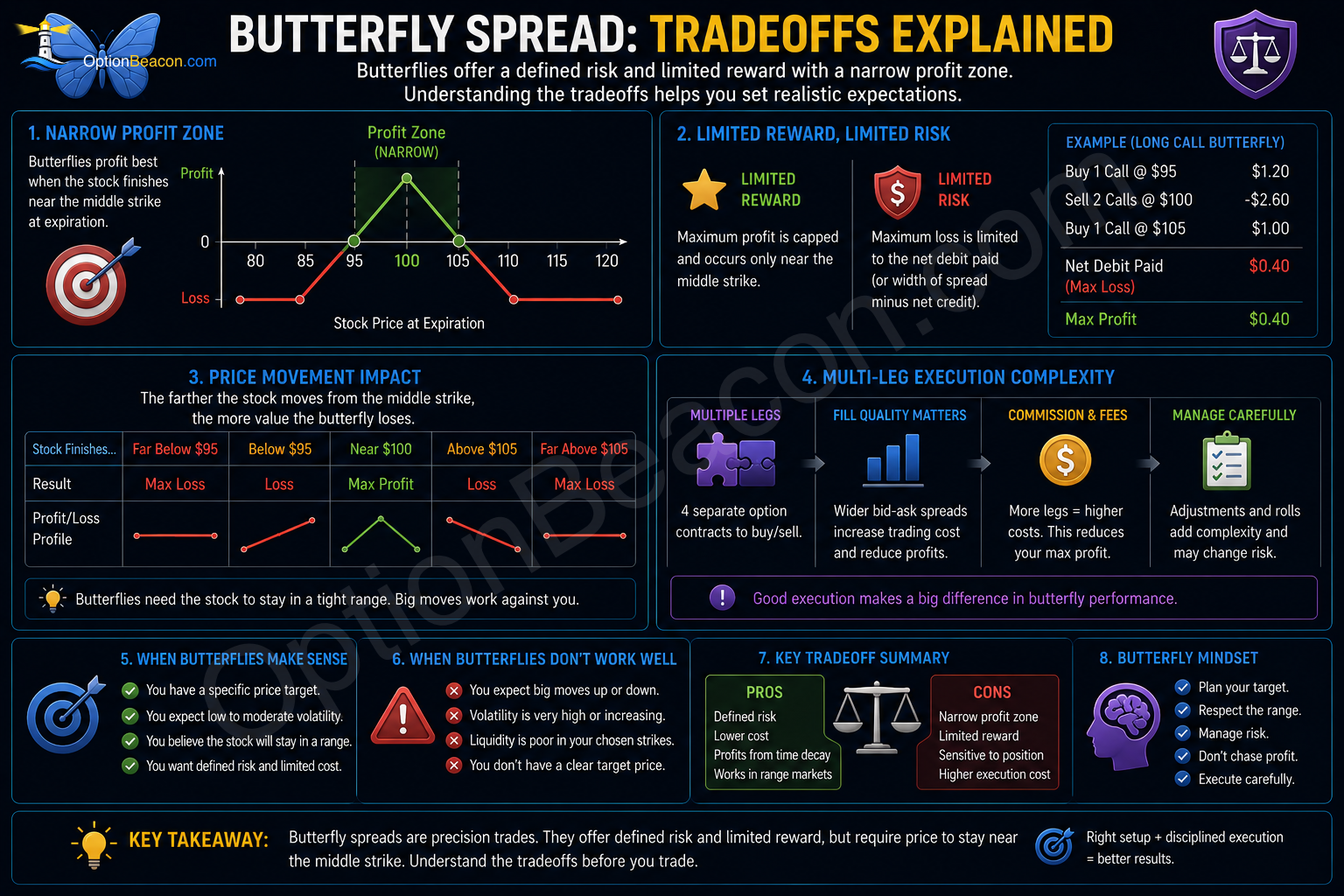
Narrow Profit Zone
The stock usually needs to finish near the target area.
Limited Reward
Profit potential is capped.
Timing Matters
Even correct direction may not be enough.
Liquidity Matters
Multi-leg execution quality becomes very important.
Wide spreads across four contracts can damage performance.
Time Decay and Butterflies
Butterflies often become more sensitive near expiration.
This creates both:
- Opportunity.
- Risk.
As expiration approaches:
- Gamma may increase sharply.
- Small stock moves may change P/L rapidly.
- Assignment risk may increase on short strikes.
This is why many traders:
- Close butterflies before expiration.
Instead of holding through final settlement.
Volatility and Butterfly Spreads
Butterflies are often sensitive to implied volatility changes.
Generally:
| Volatility Environment | Typical Effect |
|---|---|
| Falling IV | Can help some butterflies |
| Rising IV | Can widen expected movement and hurt positioning |
Large volatility expansion often hurts range-focused trades.
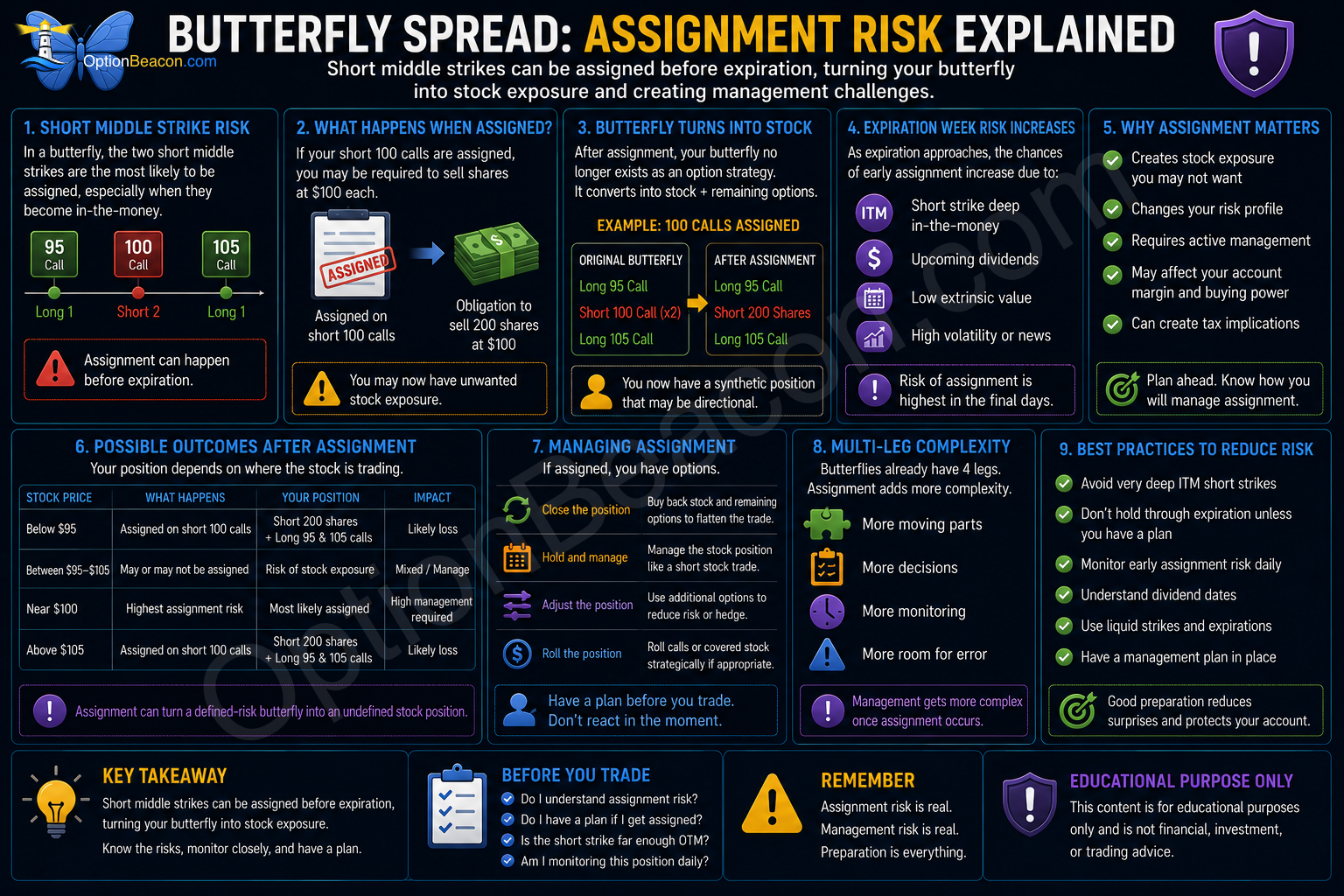
Assignment Risk
Butterflies contain short options.
This means:
- Assignment can occur before expiration.
Especially when:
- Short strikes become deep in the money.
- Dividends approach.
- Expiration nears.
Early assignment can temporarily create:
- Long stock.
- Short stock.
- Unexpected directional exposure.
Professional Trader Lens
Professionals usually use butterflies when they have:
- A precise target area.
- Volatility expectations.
- Defined risk requirements.
- Strong execution discipline.
Professionals also pay close attention to:
- Liquidity.
- Bid-ask spreads.
- Implied volatility.
- Expiration timing.
- Event risk.
A professional process usually starts with:
- Underlying thesis.
- Expected movement range.
- Volatility environment.
- Strike selection.
- Expiration selection.
- Position sizing.
The option structure expresses the idea — not the idea itself.
Risks and Tradeoffs
Butterflies Are Precision Trades
The stock often needs to stay near a specific range.
Large Moves Can Hurt Quickly
Butterflies are not designed for explosive movement.
Multi-Leg Execution Adds Friction
Commissions and spreads matter more.
Expiration Risk Increases Near the End
Gamma and assignment risk can rise sharply.
Emotional Adjustments Can Increase Complexity
Repeated rolling or leg adjustments may distort original risk structure.
Common Mistakes
Trading Illiquid Butterflies
Poor fills can damage performance immediately.
Using Butterflies Without a Target Thesis
Butterflies require a price-location idea, not just direction.
Holding Too Close to Expiration
Expiration week can become highly unstable.
Ignoring Assignment Risk
Short middle strikes can create unexpected exposure.
Confusing Defined Risk With Easy Profit
Defined risk does not mean high probability.
Most beginner mistakes come from focusing on premium instead of total structure behavior, volatility exposure, and expiration dynamics.
Butterfly vs Other Strategies
| Strategy | Outlook |
|---|---|
| Long Call | Strong bullish |
| Covered Call | Mild bullish |
| Iron Condor | Neutral range |
| Butterfly | Precise target range |
| Long Straddle | Large movement expected |
Butterflies are generally:
- More precise and less forgiving.
Than simpler directional trades.
Practical Checklist
Before entering a butterfly:
- Is there a clear target price area?
- Is liquidity acceptable?
- Is implied volatility appropriate?
- Is expiration timing reasonable?
- Do you understand max loss?
- Are commissions manageable?
- Is assignment risk acceptable?
- Do you understand the payoff shape?
Related Guides
Continue learning:
- Iron Condors Explained
- How to Choose the Right Strike Price
- The Greeks: Delta, Gamma, Theta, and Vega
- Options Expiration and Time Decay
- Risks of Options Trading
Key Takeaways
- Butterfly spreads use four option legs.
- Risk and reward are both limited.
- Best outcome usually occurs near the middle strike.
- Butterflies are range-focused strategies.
- Liquidity and execution quality matter.
- Time decay and volatility both affect performance.
- Assignment risk exists on short legs.
- Butterflies require precise trade planning.
FAQ
Is a butterfly spread advanced?
It is more advanced than single-leg options because it contains multiple legs and more complex payoff behavior.
Is butterfly risk defined?
Traditional long butterflies usually have defined risk before fees and slippage.
When is max profit possible?
Often when the underlying finishes near the short middle strike at expiration.
Do butterflies benefit from large stock moves?
Usually no. Butterflies typically prefer controlled or range-bound movement.
Why are butterflies cheaper than some directional trades?
Because selling the two middle strikes helps offset the cost of the long wings.
Can butterflies be assigned early?
Yes. Short middle strikes can be assigned before expiration. ## Educational Disclaimer OptionBeacon provides educational content only and does not provide financial, investment, or trading advice.