


Options Strategies
Earnings Plays: Trading Options Around Earnings Reports
Understand why earnings options can become expensive, volatile, and risky — even when the stock moves in the expected direction.
Overview
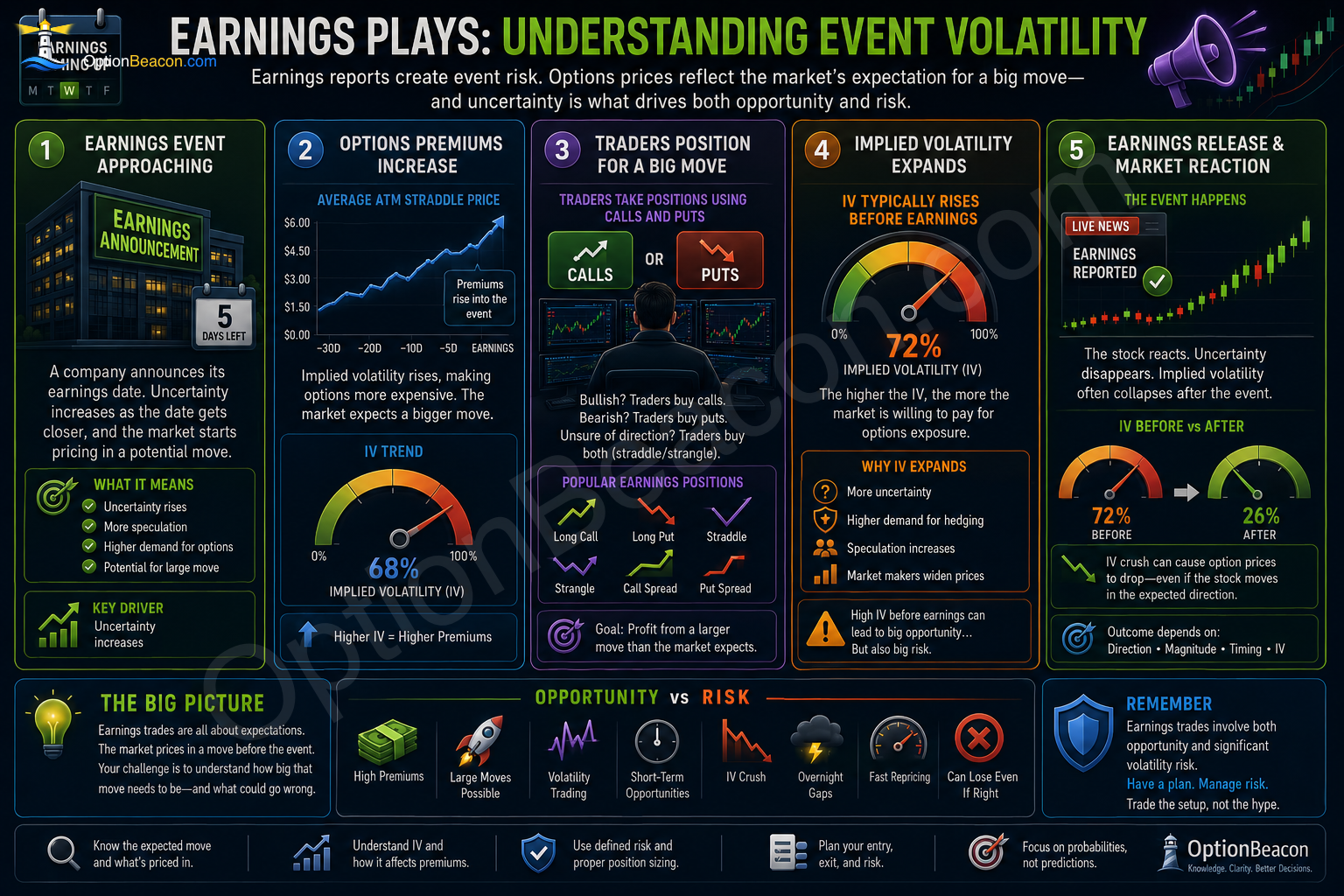
Earnings season is one of the most active and volatile periods in the options market.
Before a company reports earnings:
- Uncertainty increases.
- Traders speculate on the reaction.
- Institutions hedge positions.
- Implied volatility often rises sharply.
As implied volatility rises:
- Options premiums frequently become more expensive.
- Expected move pricing expands.
- Short-term contracts may react aggressively.
After earnings are released:
- Uncertainty disappears.
- Implied volatility often collapses.
- Options may rapidly lose value.
This creates one of the most misunderstood situations in options trading:
- A trader can correctly predict stock direction and still lose money.
Earnings trades are not only:
- Directional trades.
They are also:
- Volatility trades.
- Timing trades.
- Expected-move trades.
This guide explains earnings plays in practical terms. It is written for education, not as a trade recommendation. Before using any event-driven options strategy, understand implied volatility, expected move pricing, liquidity, assignment risk, expiration behavior, and overnight gap exposure.
What Are Earnings Plays?
Earnings plays are option strategies built around:
- Quarterly earnings reports.
- Company guidance.
- Major corporate announcements.
Traders attempt to position for:
- Bullish movement.
- Bearish movement.
- Large volatility expansion.
- Post-event volatility collapse.
Common earnings strategies include:
- Long calls.
- Long puts.
- Straddles.
- Strangles.
- Debit spreads.
- Credit spreads.
- Iron condors.
- Volatility-focused structures.
Some traders seek:
- Large directional moves.
While others attempt to benefit from changing volatility conditions.
How Earnings Options Work
Step 1 — Implied Volatility Often Rises Before Earnings
Before earnings:
- Uncertainty increases.
- Speculation rises.
- Traders expect larger movement.
As a result:
- Implied volatility often rises.
- Option premiums become more expensive.
Higher IV reflects:
- Higher expected movement.
- Higher uncertainty.
- Greater demand for options exposure.
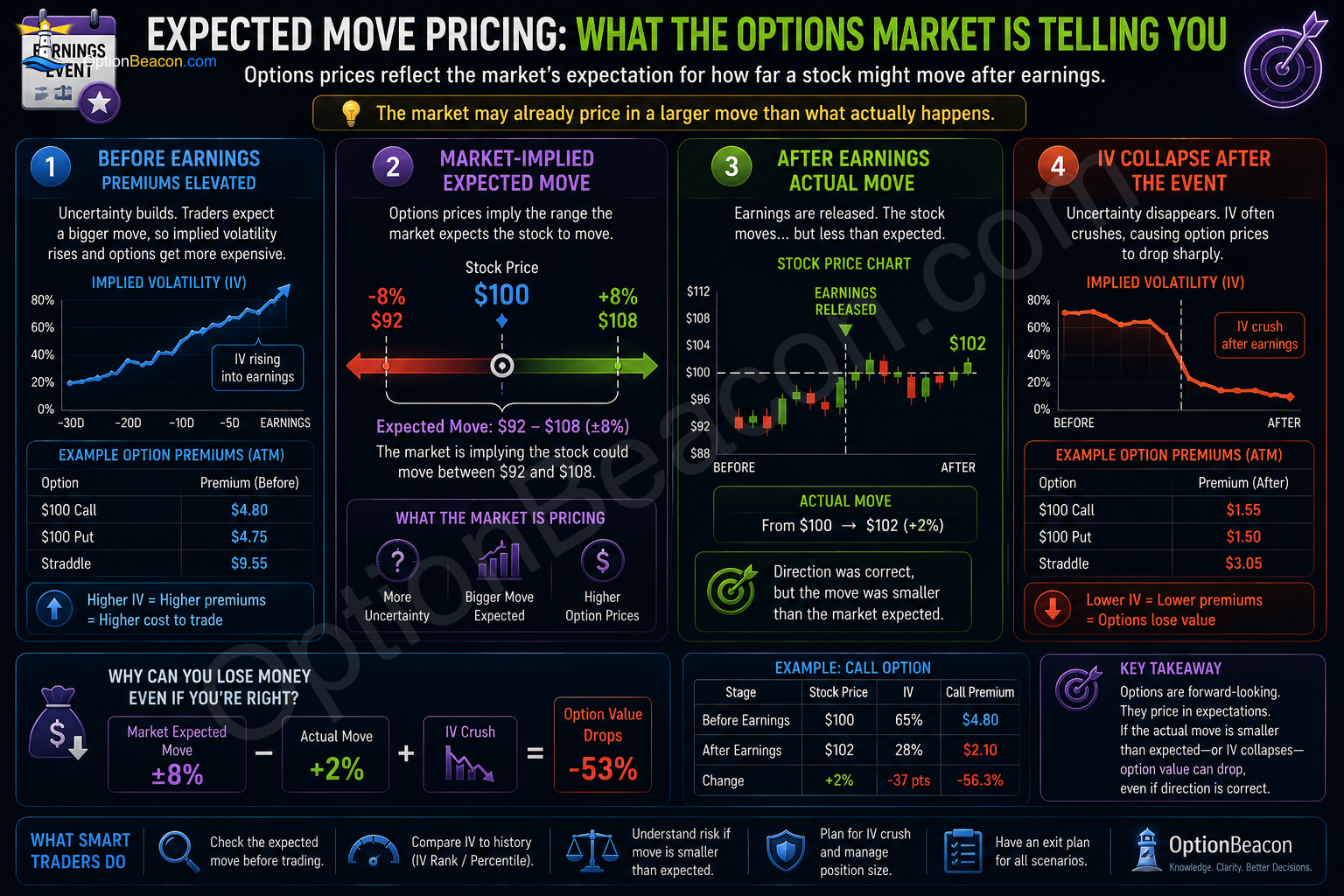
Step 2 — The Market Prices an Expected Move
Options pricing often implies how far the market expects the stock to move after earnings.
Example:
| Stock Price | Expected Move |
|---|---|
| $100 | ±8% |
The market may be implying:
- Possible movement toward $92.
- Or toward $108.
This expected move becomes embedded into option pricing before earnings.
Step 3 — Earnings Are Released
After earnings:
- The uncertainty disappears.
- Implied volatility often compresses rapidly.
- Options premiums may fall sharply.
This is commonly called:
- IV crush.
IV crush affects many:
- Calls.
- Puts.
- Straddles.
- Short-dated speculative positions.
Even if the stock moves in the expected direction:
- The option may still lose value if the move was smaller than expected.
Step 4 — The Position Reacts to Multiple Variables
Earnings options react to:
- Stock direction.
- Implied volatility.
- Time decay.
- Gamma exposure.
- Expected-move repricing.
This is why earnings trades are often much more complex than beginners expect.
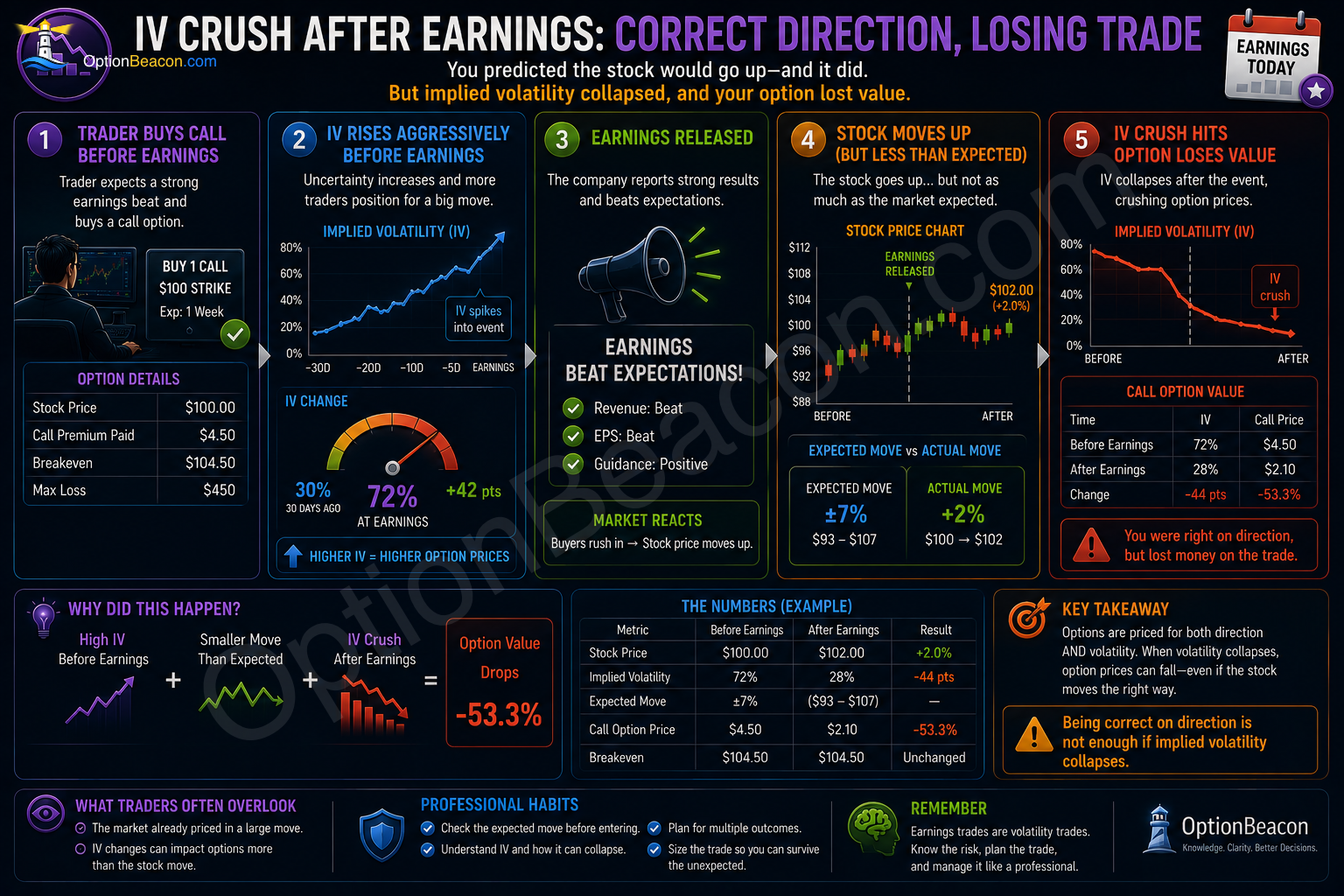
Real Example
A trader buys:
- 1 weekly call option before earnings.
The company reports:
- Strong revenue.
- Positive guidance.
- Beats analyst expectations.
The stock rises:
- 2%.
However:
- The options market had priced in a ±7% move.
- Implied volatility collapses after earnings.
- The call option loses value.
The trader correctly predicted direction — but still lost money.
Examples are simplified so the mechanics are easier to see. Real trades also include commissions, fees, taxes, changing implied volatility, assignment risk, and execution quality.
Why Traders Use Earnings Strategies
Some traders use earnings plays to:
- Speculate on large movement.
- Trade volatility expansion.
- Benefit from volatility collapse.
- Hedge stock exposure.
- Attempt short-term opportunities.
Earnings periods often create:
- Larger premiums.
- Higher trading volume.
- Faster option repricing.
For some traders:
- Earnings events represent opportunity.
For others:
- They represent elevated risk that should be avoided entirely.
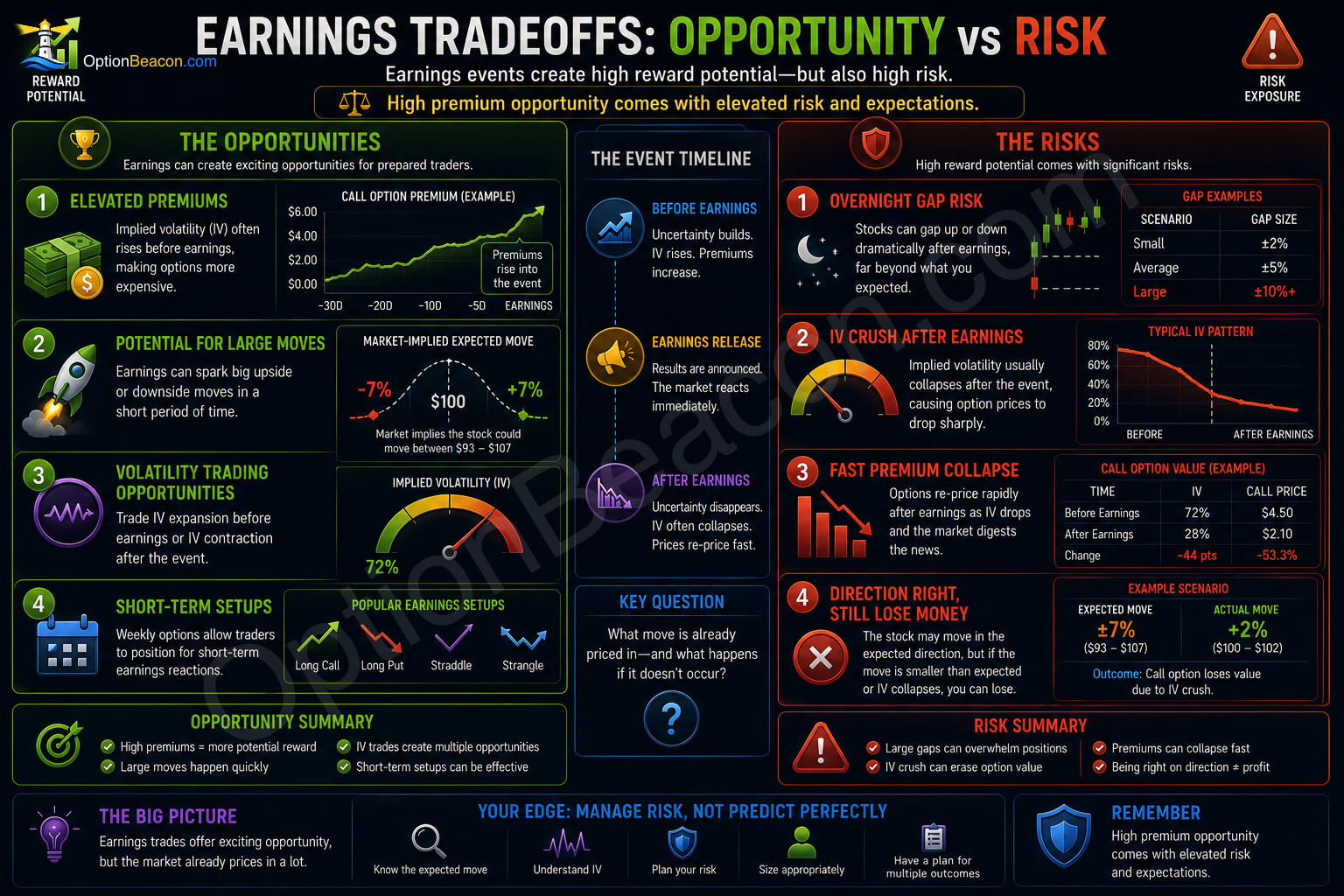
Understanding the Tradeoff
Earnings options can offer:
- Large short-term opportunity.
- Fast movement.
- Elevated premium levels.
But they also create:
- Overnight gap risk.
- Volatility collapse risk.
- Aggressive repricing.
This is why professionals ask:
- What move is already priced in?
Not simply:
- Will the stock go up or down?
Professional Trader Lens
Professionals understand that earnings trades are:
- Volatility trades.
- Not just directional bets.
Professional traders often compare:
- Implied move.
- Historical earnings reactions.
- Implied volatility rank.
- Liquidity.
- Sector conditions.
- Realistic probability scenarios.
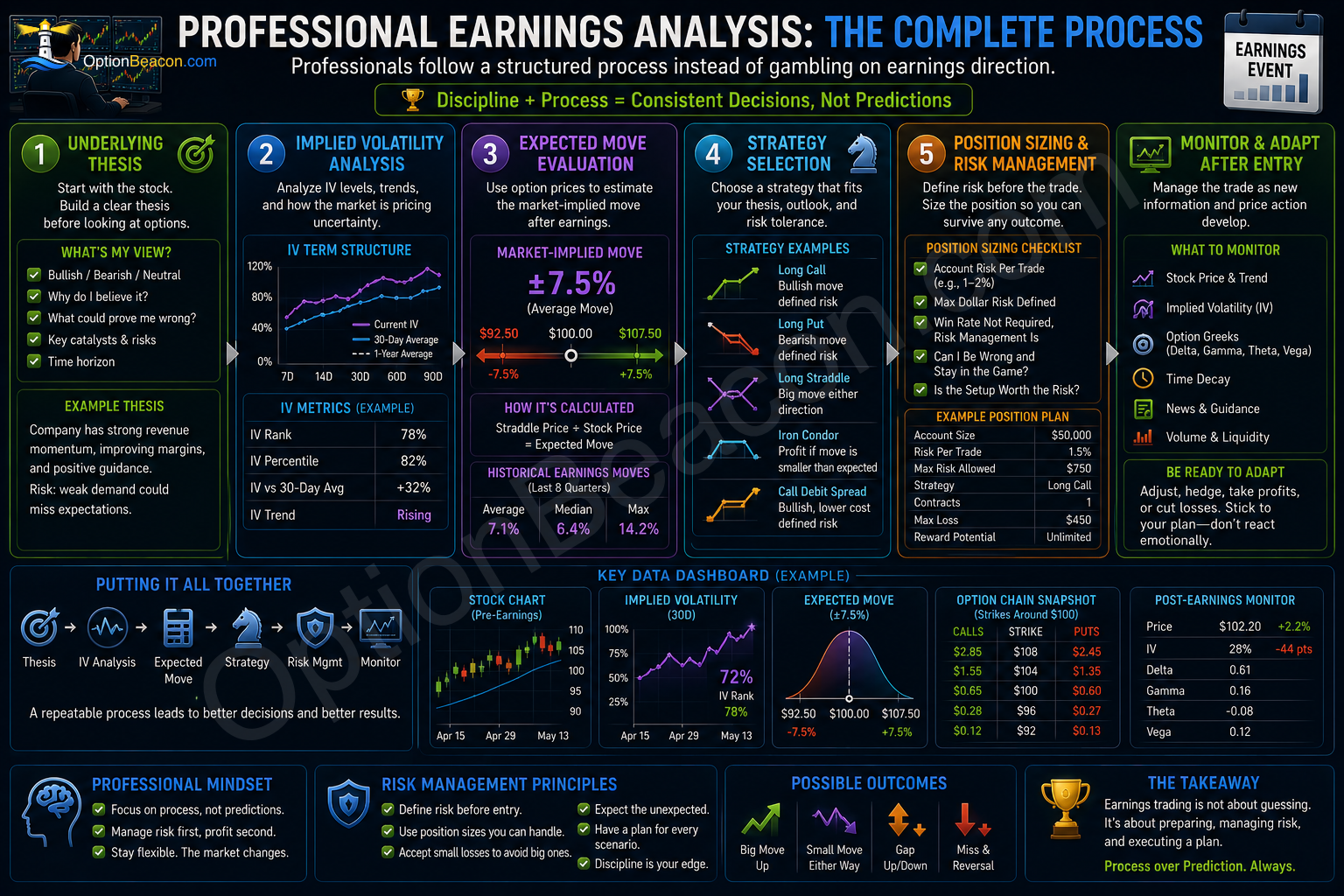
A professional process usually starts with:
1. Underlying thesis. 2. Volatility analysis. 3. Expected move evaluation. 4. Strategy selection. 5. Position sizing. 6. Risk management planning.
The option contract expresses the idea — not the idea itself.
Risks and Tradeoffs
IV Crush Risk
Long options may rapidly lose value after earnings.
Gap Risk
Stocks can move dramatically overnight.
Liquidity Risk
Bid-ask spreads can widen before and after earnings.
Gamma Risk
Short-dated options can change value extremely quickly.
Assignment Risk
Short options may be assigned unexpectedly.
Emotional Decision-Making Risk
Fast earnings movement may encourage impulsive trading behavior.
Risk should be reviewed:
- Before entry.
- During the trade.
- After the position changes.
Options exposure evolves quickly because:
- Delta.
- Gamma.
- Theta.
- Vega.
Are not static.
A position that initially looked conservative can become aggressive after:
- A large move.
- Rapid IV changes.
- Expiration acceleration.
Common Mistakes
Buying Options Only Because Earnings Are Coming
Event-driven volatility alone is not a strategy.
Selling Premium Without Respecting Gap Risk
Short premium strategies can experience large overnight losses.
Ignoring Expected Move Pricing
A stock can rise and the option can still lose money.
Ignoring Prior Earnings Reactions
Historical earnings behavior matters.
Oversizing Event Trades
Earnings reactions can exceed expectations rapidly.
Most beginner mistakes come from focusing on:
- Premium opportunity.
- Excitement.
- Speed.
Instead of:
- Probabilities.
- Volatility pricing.
- Total exposure.
Premium is visible immediately.
But:
- Obligation.
- Assignment risk.
- Opportunity cost.
- Drawdown exposure.
Matter just as much.
Practical Checklist
Before entering an earnings trade:
- Can you explain the strategy without looking at the order ticket?
- What move is already priced in?
- Do you know the maximum planned loss?
- Do you know the realistic worst-case scenario?
- Have you checked implied volatility?
- Have you checked liquidity and spreads?
- Do you understand overnight gap exposure?
- Do you know how IV crush may affect the trade?
- Is the position small enough that you can follow your plan?
Related Guides
Continue learning:
- Understanding Implied Volatility
- The Greeks: Delta, Gamma, Theta, and Vega
- Options Expiration and Time Decay
- How to Read an Options Chain
- Risks of Options Trading
Key Takeaways
- Earnings trades involve both direction and volatility.
- Implied volatility often rises before earnings.
- Expected move pricing matters.
- IV crush can rapidly reduce option value.
- Correct direction does not guarantee profit.
- Gap risk can become significant.
- Professionals focus heavily on risk management.
- Position sizing matters more than excitement.
FAQ
Are earnings options good for beginners?
Usually not. Earnings introduce: - Fast-moving volatility. - Overnight gap risk. - Rapid repricing.
What is the expected move?
It is a market-implied estimate of potential stock movement inferred from option pricing.
Why can options lose money after good earnings?
Because: - The move may be smaller than expected. - Implied volatility may collapse aggressively after the report.
Can spreads help reduce risk?
Spreads can define theoretical risk, but they still require: - Proper sizing. - A clear thesis. - Disciplined risk management. ## Educational Disclaimer OptionBeacon provides educational content only and does not provide financial, investment, or trading advice.