


Options Basics
How to Read an Options Chain
Learn the key parts of an options chain, including strike prices, expiration dates, bid-ask spreads, volume, and open interest.
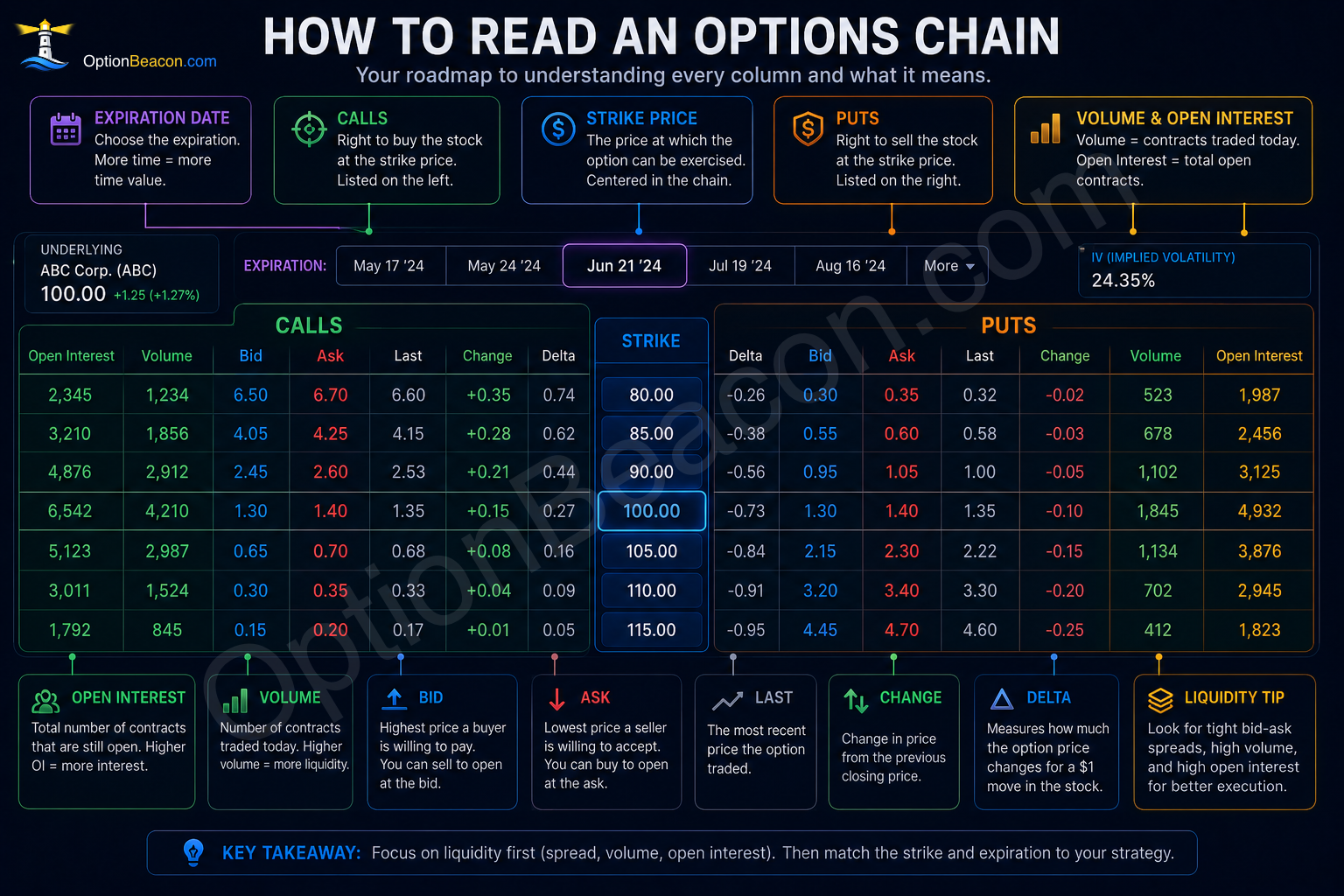
Overview
An options chain is the menu of available contracts.
It shows:
- Expiration dates.
- Strike prices.
- Calls and puts.
- Bid and ask prices.
- Volume.
- Open interest.
Reading an options chain correctly helps traders understand:
- Pricing.
- Liquidity.
- Probability.
- Contract availability.
- Transaction friction.
This guide explains the idea in practical terms. It is written for education, not as a trade recommendation. Before using any options strategy, understand the contract, the maximum realistic loss, the expiration date, liquidity, and what could happen if the position is assigned or exercised.
Simple Explanation
An options chain is similar to a pricing table.
Each row represents a contract with:
- A strike price.
- Expiration date.
- Call and put pricing.
- Trading activity.
The chain helps traders answer questions like:
- Which strike should I use?
- How expensive is the option?
- Is the contract liquid?
- How much time remains?
The options chain is one of the most important tools in options trading.
The Main Parts of an Options Chain
Expiration Date
Expiration tells you how much time remains before the contract expires.
Different expirations affect:
- Time decay.
- Premium.
- Probability.
- Volatility exposure.
Short-dated contracts often move faster and decay faster.
Longer-dated contracts usually cost more because they contain more time value.
Strike Price
The strike price defines the exercise price of the contract.
Different strikes represent different assumptions and probabilities.
For example:
| Stock Price | Call Strike | Interpretation |
|---|---|---|
| $100 | $95 Call | In the money |
| $100 | $100 Call | At the money |
| $100 | $105 Call | Out of the money |
Strike selection affects:
- Premium cost.
- Probability.
- Delta exposure.
- Breakeven.
- Assignment risk.
Bid and Ask
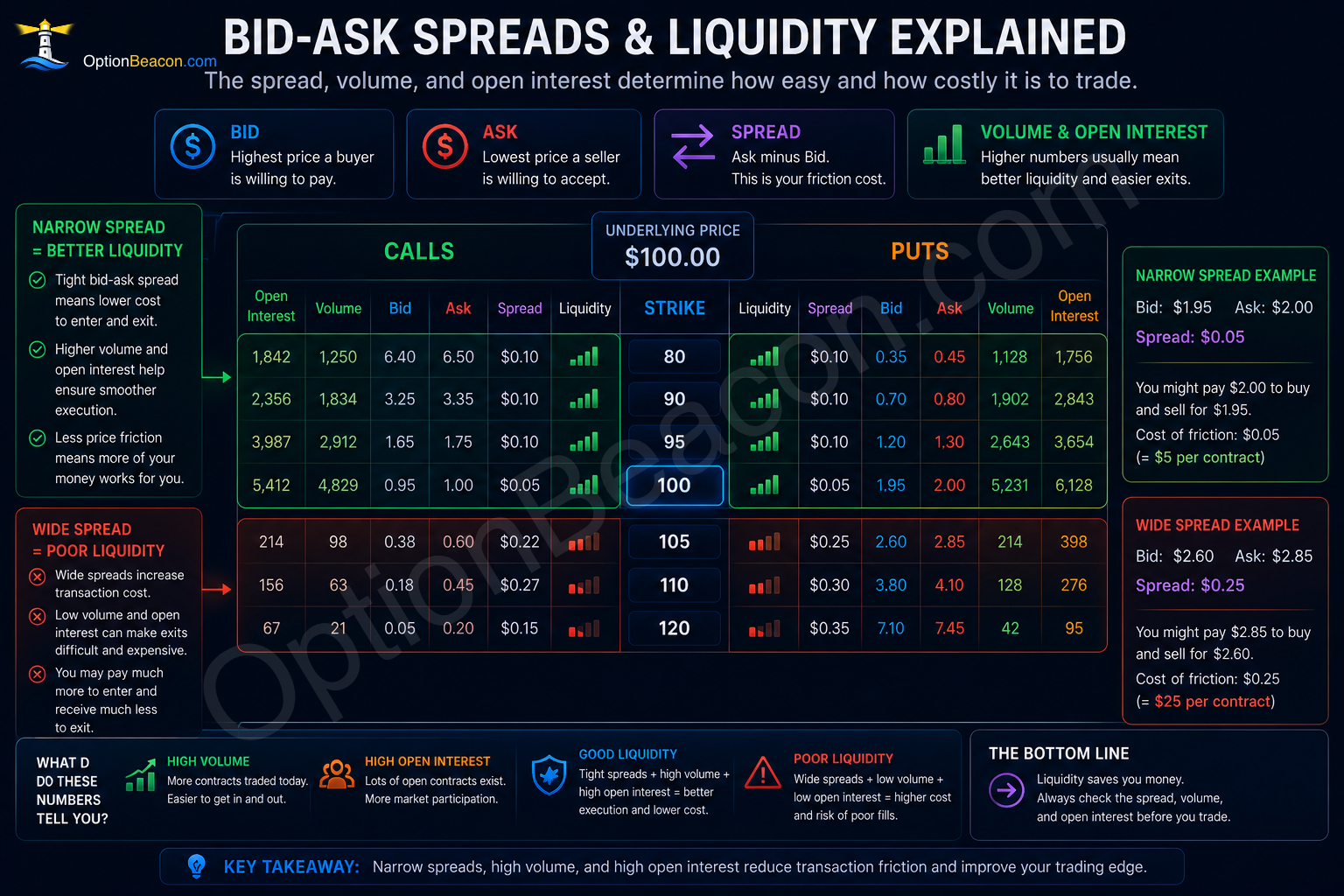
The bid is the highest current buying offer.
The ask is the lowest current selling offer.
The difference between them is called the bid-ask spread.
Example:
| Bid | Ask | Spread |
|---|---|---|
| $1.10 | $1.30 | $0.20 |
On a standard 100-share contract:
- $0.20 spread = approximately $20 friction.
Wide spreads can make trades expensive before they even begin.
Volume
Volume measures how many contracts traded during the current session.
Higher volume may indicate:
- Stronger liquidity.
- More market participation.
- Easier entries and exits.
Low volume does not automatically mean bad, but it may reduce execution quality.
Open Interest
Open interest measures the number of contracts that remain open from previous trading activity.
Higher open interest often suggests:
- More active participation.
- Potentially better liquidity.
- More established contract activity.
Open interest is not directional.
It does not tell you whether traders are bullish or bearish.
How Traders Read an Options Chain
Professional traders rarely look at only one number.
They evaluate the chain as a complete structure.
Typical process:
- Choose expiration.
- Review implied volatility.
- Compare strike prices.
- Check bid-ask spread.
- Evaluate volume and open interest.
- Match contract to trade thesis.
The options chain is not just a pricing screen.
It is a probability and liquidity map.
Real Example
Suppose a call option shows:
| Bid | Ask |
|---|---|
| $1.10 | $1.30 |
The spread is:
- $0.20.
On a standard 100-share contract:
- $20 difference per contract.
If the trader buys near the ask and later sells near the bid, friction alone may create a loss even before market movement is considered.
Examples are simplified so the mechanics are easier to see. Real trades also include commissions, fees, taxes, changing implied volatility, early assignment risk, and execution quality.
Weekly vs Monthly Expirations
Options chains often contain:
- Weekly expirations.
- Monthly expirations.
- LEAPS, or long-dated contracts.
Weekly options:
- Decay faster.
- React aggressively to movement.
- May carry higher gamma exposure.
Monthly contracts often:
- Provide more time.
- Decay slower.
- Offer more flexibility.
Long-dated contracts typically:
- Cost more.
- Contain more time value.
- React differently to implied volatility.
Professional Trader Lens
Professionals often start with liquidity.
A beautiful strategy on an illiquid chain can become a poor trade because entries and exits are inefficient.
Professional traders also examine:
- Implied volatility.
- Event timing.
- Spread width.
- Assignment exposure.
- Execution quality.
A professional process usually starts with:
- The underlying stock.
- Implied volatility.
- Strategy selection.
- Strike selection.
- Position size.
The option contract is the expression of the idea, not the idea itself.
Risks and Tradeoffs
- Wide bid-ask spreads increase transaction friction.
- Low open interest can make exits difficult.
- Short-dated contracts may decay faster than beginners expect.
- Illiquid chains may create poor fills.
- Cheap contracts can still carry large risk.
Risk should be reviewed before entry and again after the trade changes.
Options positions can evolve quickly because delta, gamma, theta, and vega are not static.
A position that looked conservative at entry can become aggressive after a large move or as expiration approaches.
Common Mistakes
Choosing the cheapest option without checking liquidity
Cheap options may have poor spreads and difficult execution.
Ignoring expiration cycles around earnings or dividends
Major events can dramatically change pricing and implied volatility.
Confusing last traded price with realistic fill price
The last traded price may not reflect current executable pricing.
Ignoring open interest
Low open interest may reduce flexibility when exiting positions.
Looking only at premium
Premium alone does not show:
- Liquidity.
- Probability.
- Assignment risk.
- Volatility exposure.
Most beginner mistakes come from focusing on premium instead of total exposure.
Premium is visible immediately, but the obligation, drawdown, opportunity cost, and assignment scenario matter just as much.
Practical Checklist
Before entering a contract from the options chain:
- Have you checked expiration date?
- Do you understand the strike selection?
- Is the bid-ask spread reasonable?
- Is volume high enough for acceptable liquidity?
- Is open interest sufficient?
- Are earnings or major events approaching?
- Does the position size fit your risk tolerance?
What Makes an Options Chain Good?
There is no perfect chain.
However, traders often prefer contracts with:
- Tighter bid-ask spreads.
- Higher open interest.
- Higher volume.
- Consistent liquidity.
- Reasonable implied volatility.
Good execution quality can matter more than finding the perfect strategy.
Related Beginner Guides
Continue learning:
- How to Choose the Right Strike Price
- Understanding Implied Volatility
- Options Expiration and Time Decay
- Common Options Strategies for Beginners
- Risks of Options Trading
Key Takeaways
- An options chain shows available contracts and pricing.
- Expiration affects time decay and premium.
- Strike price changes probability and exposure.
- Bid-ask spread affects execution quality.
- Volume and open interest help estimate liquidity.
- Cheap contracts are not always good opportunities.
- Liquidity matters more than many beginners realize.
FAQ
What is open interest?
Open interest is the number of contracts that remain open from prior trading activity.
Is high volume always better?
Higher volume may improve liquidity, but traders should still check bid-ask spread and execution quality.
Should beginners use weekly options?
Weekly options can be useful to study, but they decay quickly and require a clear plan.
What is a good bid-ask spread?
Generally, tighter spreads are better because they reduce transaction friction.
Why do some options have almost no volume?
Some strikes or expirations attract less trader interest and may be less liquid.
Is the last traded price important?
It provides context, but current bid and ask prices are often more relevant for actual execution.