


Options Basics
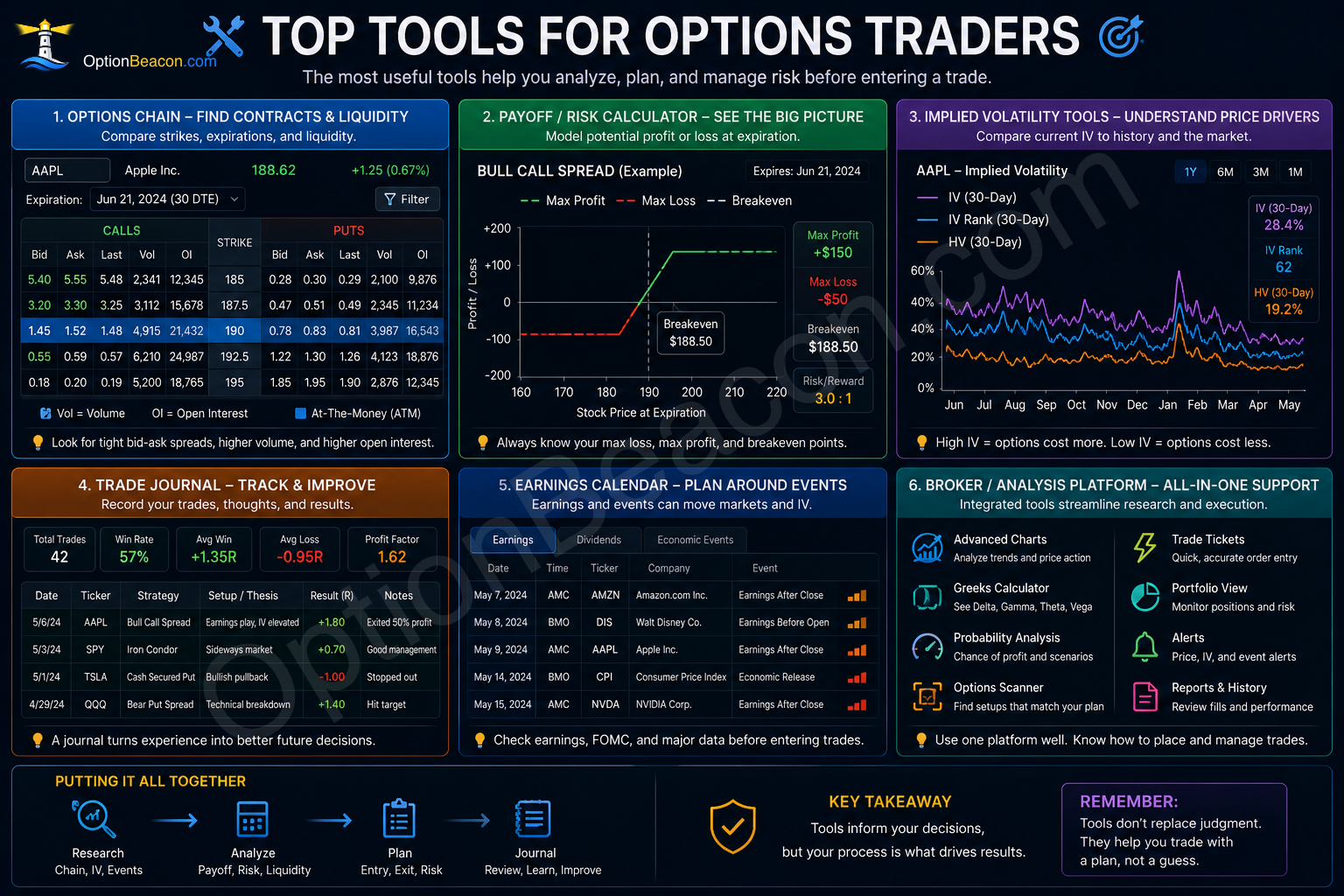
Top Tools for Options Traders
Learn the research, analysis, and risk tools options traders commonly use before entering a trade.
Overview
Tools do not make a trader profitable.
But they can make:
- Risk more visible.
- Trade structure clearer.
- Execution mistakes less likely.
The most useful tools help traders analyze:
- Pricing.
- Payoff.
- Volatility.
- Liquidity.
- Probability.
- Position sizing.
- Trade journaling.
Professional traders rely on process, not just intuition.
Tools support that process.
This guide explains the idea in practical terms. It is written for education, not as a trade recommendation. Before using any options strategy, understand the contract, the maximum realistic loss, the expiration date, liquidity, and what could happen if the position is assigned or exercised.
Simple Explanation
Most options tools answer one of these questions:
- What am I risking?
- What could I realistically make?
- How liquid is this contract?
- How sensitive is this position?
- What happens if volatility changes?
- What is my exit plan?
The goal is not prediction.
The goal is better decision-making and clearer risk visibility.
The Options Chain
The options chain is the foundation of most options analysis.
It displays:
- Strike prices.
- Expiration dates.
- Bid prices.
- Ask prices.
- Volume.
- Open interest.
The chain helps traders compare contracts quickly.
Why It Matters
The chain helps identify:
- Liquidity.
- Spread quality.
- Available expirations.
- Pricing differences.
- Unusual activity.
Poor liquidity may create:
- Bad fills.
- Higher transaction friction.
- Difficult exits.
What Beginners Should Focus On
Beginners should primarily learn:
- Expiration dates.
- Strike prices.
- Bid vs ask.
- Open interest.
- Volume.
Understanding these basics prevents many avoidable mistakes.
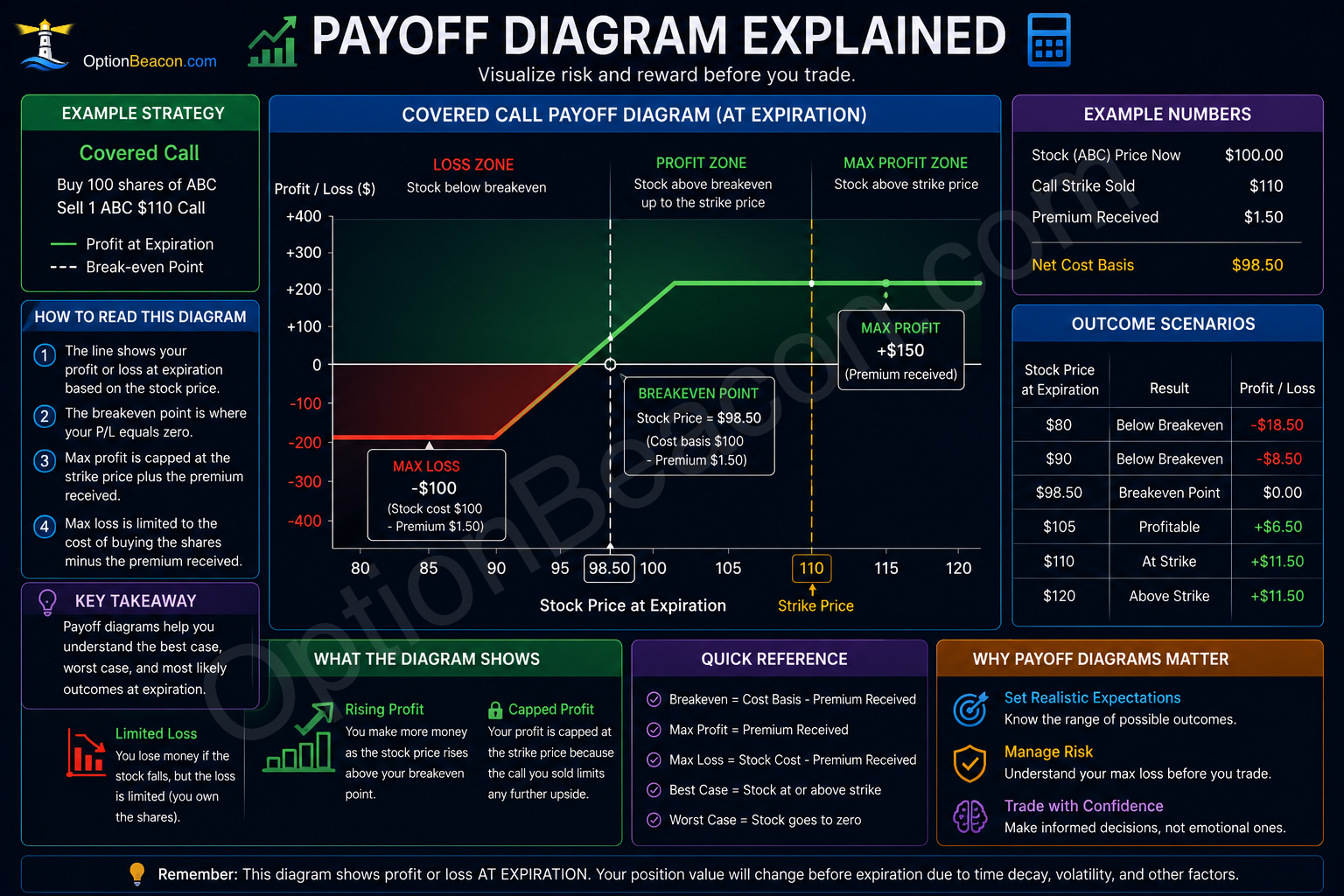
Payoff Calculators
A payoff calculator models:
- Max profit.
- Max loss.
- Breakeven points.
- Profit/loss scenarios.
This is one of the most useful beginner tools.
Why Payoff Diagrams Matter
Many option structures behave differently than beginners expect.
A payoff calculator helps visualize:
- Capped upside.
- Limited risk.
- Assignment exposure.
- Spread structure.
- Directional assumptions.
Volatility Tools
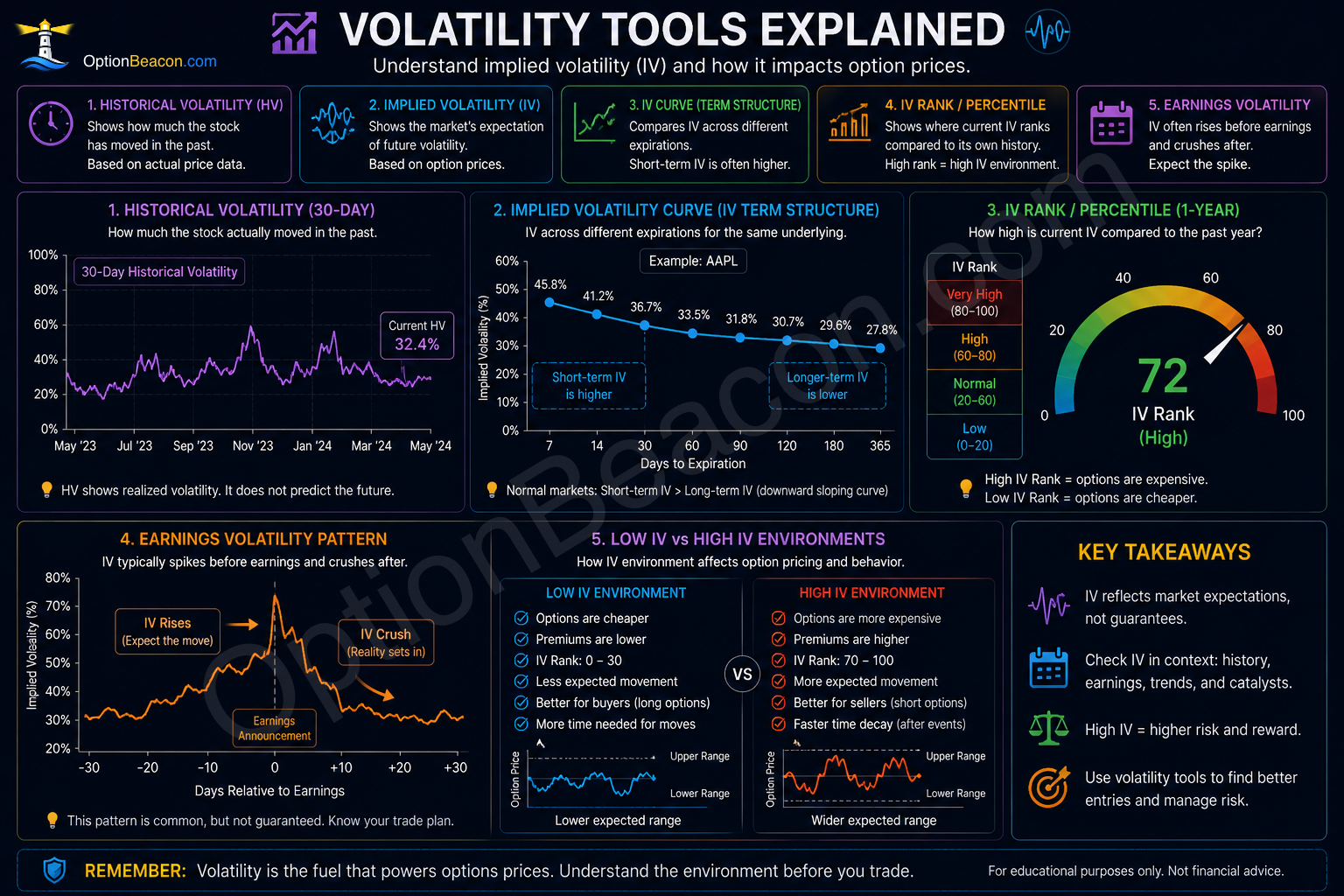
Implied volatility heavily affects option pricing.
Volatility tools help traders compare:
- Current IV.
- Historical IV.
- Volatility rank.
- Event-driven volatility.
Why Volatility Matters
Options may become:
- More expensive.
- More sensitive.
- More volatile.
During high IV environments.
Traders often monitor volatility before:
- Earnings.
- Economic reports.
- Major news events.
Common Volatility Metrics
| Metric | Purpose |
|---|---|
| IV | Current implied volatility |
| IV Rank | Relative IV vs historical range |
| IV Percentile | Frequency comparison |
| Historical Volatility | Past realized movement |
Earnings Calendars
Many option traders monitor:
- Earnings dates.
- Dividends.
- Federal Reserve announcements.
- Economic events.
Major events can dramatically affect:
- Implied volatility.
- Liquidity.
- Pricing behavior.
Why Earnings Matter
Options often become more expensive before earnings.
After earnings:
- IV crush may rapidly reduce premium value.
This is why event awareness matters.
Trade Journals
Professional traders often keep detailed journals.
A journal records:
- Trade thesis.
- Entry reason.
- Exit reason.
- Emotional state.
- Mistakes.
- Lessons learned.
Why Journaling Matters
Many trading mistakes repeat.
A journal helps identify:
- Emotional decisions.
- Poor sizing.
- Recurring setup problems.
- Risk management issues.
The goal is continuous improvement.
What a Simple Journal Might Include
| Item | Example |
|---|---|
| Strategy | Covered Call |
| Thesis | Neutral/Bullish |
| Risk Plan | Max 1% account risk |
| Exit Plan | Close at 50% profit |
| Lessons | Position size too large |
Risk Calculators
Risk calculators help estimate:
- Total exposure.
- Portfolio allocation.
- Max loss.
- Probability scenarios.
These tools help traders avoid oversized positions.
Why Position Size Matters
Even a good strategy can fail if position size is too large.
Risk management often matters more than prediction accuracy.
Broker Platforms
Most brokers provide integrated tools such as:
- Options chains.
- Charting.
- Probability analysis.
- Greeks.
- Scanners.
- Earnings calendars.
Beginners should learn:
- How orders work.
- How to read fills.
- How to review positions.
- How assignment may occur.
Before trading aggressively.
Real Example
Before selling a put spread, a trader might:
- Check the options chain.
- Compare implied volatility.
- Model the payoff.
- Review earnings dates.
- Evaluate liquidity.
- Write down an exit plan.
That process is more important than any single app.
Examples are simplified so the mechanics are easier to see. Real trades also include commissions, fees, taxes, changing implied volatility, early assignment risk, and execution quality.
Professional Trader Lens
Professionals use tools to verify a thesis, not to outsource judgment.
A model is only as useful as the assumptions entered into it.
Professional traders often ask:
- Is liquidity sufficient?
- Does the risk justify the reward?
- Is implied volatility favorable?
- Does the payoff structure match the thesis?
- What happens if volatility changes?
- What happens if the trade moves immediately against me?
Professional traders understand:
- Tools organize information, they do not eliminate uncertainty.
A professional process usually starts with:
- The underlying stock.
- Volatility.
- Strategy selection.
- Strike selection.
- Position size.
The option contract is the expression of the idea, not the idea itself.
Risks and Tradeoffs
- Tool outputs can be wrong if assumptions are wrong.
- Probability estimates are not guarantees.
- Backtests may not reflect future volatility or liquidity.
- Overconfidence in software can create poor decisions.
- Automated metrics may oversimplify risk.
Risk should be reviewed before entry and again after the trade changes.
Options positions can evolve quickly because delta, gamma, theta, and vega are not static.
A position that looked conservative at entry can become aggressive after a large move or as expiration approaches.
Common Mistakes
Relying on calculators without understanding the strategy
Tools support understanding. They do not replace it.
Ignoring liquidity
A great-looking trade may still be difficult to enter or exit efficiently.
Focusing only on premium
Premium alone does not define risk.
Skipping journaling
Many traders repeat mistakes because they never review them systematically.
Blindly trusting probability numbers
Probability models are estimates, not guarantees.
Most beginner mistakes come from focusing on premium instead of total exposure.
Premium is visible immediately, but the obligation, drawdown, opportunity cost, and assignment scenario matter just as much.
Practical Checklist
Before entering a trade:
- Have you reviewed the options chain?
- Is liquidity acceptable?
- Have you modeled the payoff?
- Did you check implied volatility?
- Are earnings or major events approaching?
- Do you know the maximum realistic loss?
- Do you have an exit plan?
- Is the position size appropriate?
Recommended Beginner Tool Categories
Beginners usually benefit most from:
| Tool Type | Why It Helps |
|---|---|
| Options Chain | Understand pricing and liquidity |
| Payoff Calculator | Visualize risk/reward |
| Volatility Charts | Understand IV behavior |
| Earnings Calendar | Avoid surprise events |
| Trade Journal | Improve decision-making |
Related Beginner Guides
Continue learning:
- How to Read an Options Chain
- Understanding Implied Volatility
- The Greeks: Delta, Gamma, Theta, and Vega
- Options Expiration and Time Decay
- Common Options Strategies for Beginners
Key Takeaways
- Tools help organize risk and pricing information.
- The options chain is foundational.
- Payoff calculators help visualize trade structure.
- Volatility tools help explain option pricing.
- Journaling improves long-term decision-making.
- Liquidity matters as much as strategy.
- Tools support judgment, they do not replace it.
FAQ
Do I need paid tools to learn options?
No. Beginners can learn core mechanics with broker tools, free education, and simple calculators.
What is the most important beginner tool?
A payoff calculator or risk diagram is often the best starting point.
Can tools predict profitable trades?
No. Tools organize information, they do not predict the future.
Why is liquidity important?
Poor liquidity may create wide spreads and difficult exits.
Should beginners use scanners?
Scanners can help organize opportunities, but beginners should first understand risk structure and execution.
Is journaling really necessary?
Many experienced traders believe journaling is one of the most valuable long-term improvement tools.