


Options Strategies
Rolling an Option: When and Why
Learn what it means to roll an option, why traders do it, and when rolling can hide risk instead of fixing it.
Overview
Rolling an option means closing an existing option position and opening a new one at a different strike price, expiration date, or both.
A roll is:
- Not a repair button.
- Not a guaranteed recovery tool.
- Not a way to erase losses.
A roll is simply:
- One trade closing and another trade opening.
Traders roll options for many reasons:
- Extend trade duration.
- Reduce assignment risk.
- Adjust strike positioning.
- Collect additional premium.
- Reduce directional exposure.
- Maintain a longer-term thesis.
Rolling can sometimes improve flexibility.
But rolling can also:
- Increase total exposure.
- Extend losing trades.
- Tie up capital longer.
- Hide realized losses inside larger positions.
This guide explains rolling in practical terms. It is written for education, not as a trade recommendation. Before using any options strategy, understand the contract, the maximum realistic loss, expiration behavior, liquidity, assignment risk, and how cumulative adjustments affect exposure.
Simple Explanation
Rolling usually means:
1. Close the current option. 2. Open a replacement option. 3. Adjust strike, expiration, or both.
Common roll directions include:
| Roll Type | Meaning |
|---|---|
| Roll Out | Move to a later expiration |
| Roll Up | Move strike higher |
| Roll Down | Move strike lower |
| Roll Forward | Extend time |
| Roll Diagonal | Change both strike and expiration |
Why Traders Roll Options
Rolling is usually done to modify risk exposure.
Extend Time for the Thesis
A trader may still believe in the original market idea but need more time.
Example:
- The stock has not moved enough before expiration.
Rolling to a later expiration may extend the opportunity window.
Reduce Assignment Risk
Short option sellers sometimes roll to avoid near-term assignment pressure.
This is common with:
- Covered calls.
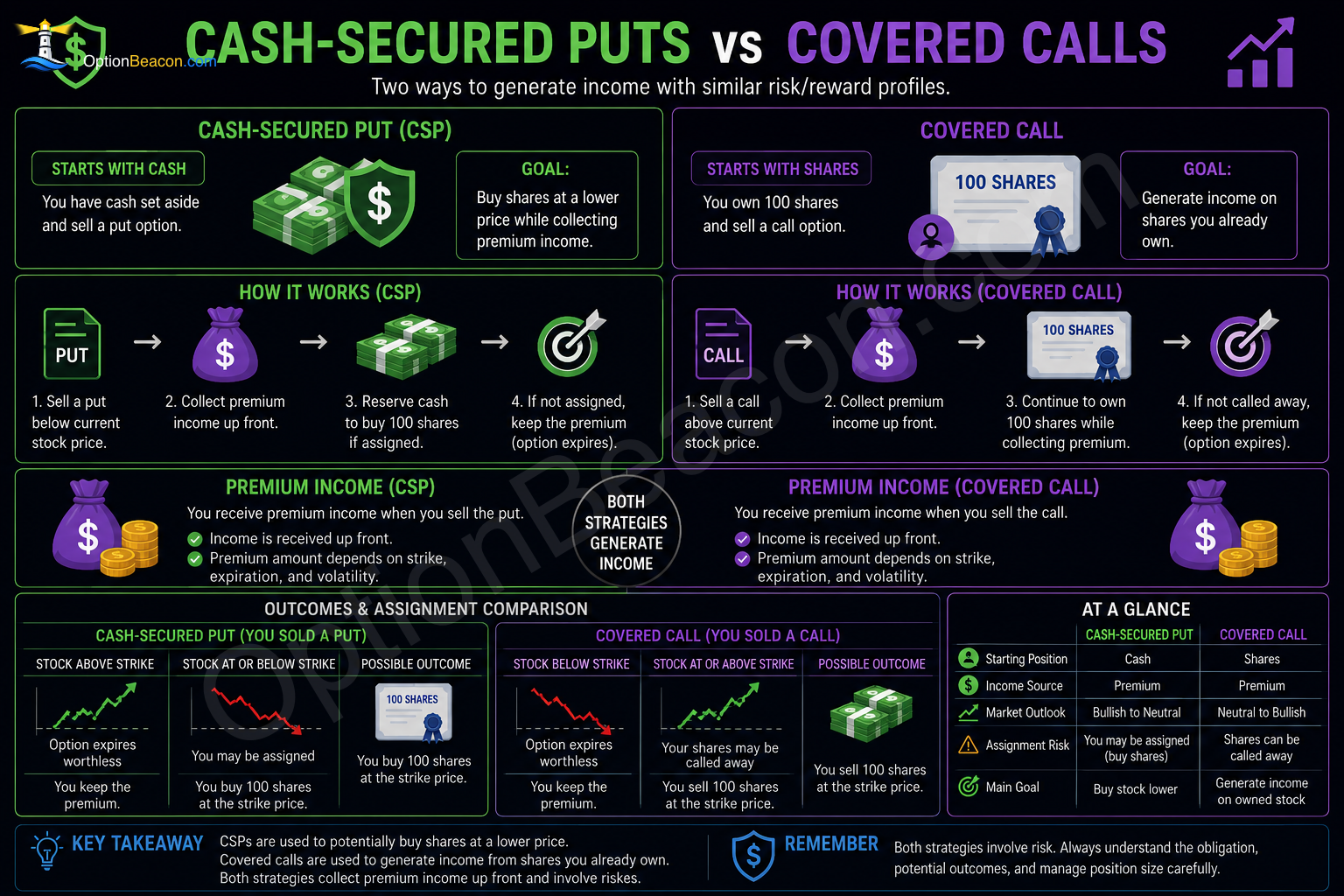
- Cash-secured puts.
- Credit spreads.
Improve Strike Positioning
A trader may want:
- More distance from current price.
- Higher probability.
- Lower directional exposure.
This often involves rolling strikes farther away.
Collect Additional Premium
Some rolls collect additional premium.
This can:
- Partially offset prior losses.
- Reduce cost basis.
- Increase total collected credit.
But:
- Collecting more premium does not automatically reduce total risk.
How Rolling Works
Step 1 — Close the Existing Position
The current option is bought back or sold to close.
This realizes:
- Profit.
- Loss.
- Partial recovery.
Step 2 — Open a New Position
The replacement position may change:
- Expiration.
- Strike.
- Directional exposure.
- Volatility exposure.
- Assignment risk.
Step 3 — Evaluate Net Credit or Debit
A roll may produce:
| Type | Meaning |
|---|---|
| Net Credit | More premium collected |
| Net Debit | Additional capital spent |
A credit roll is not automatically superior.
The important question is:
- Is the new position attractive on its own?
Common Rolling Scenarios
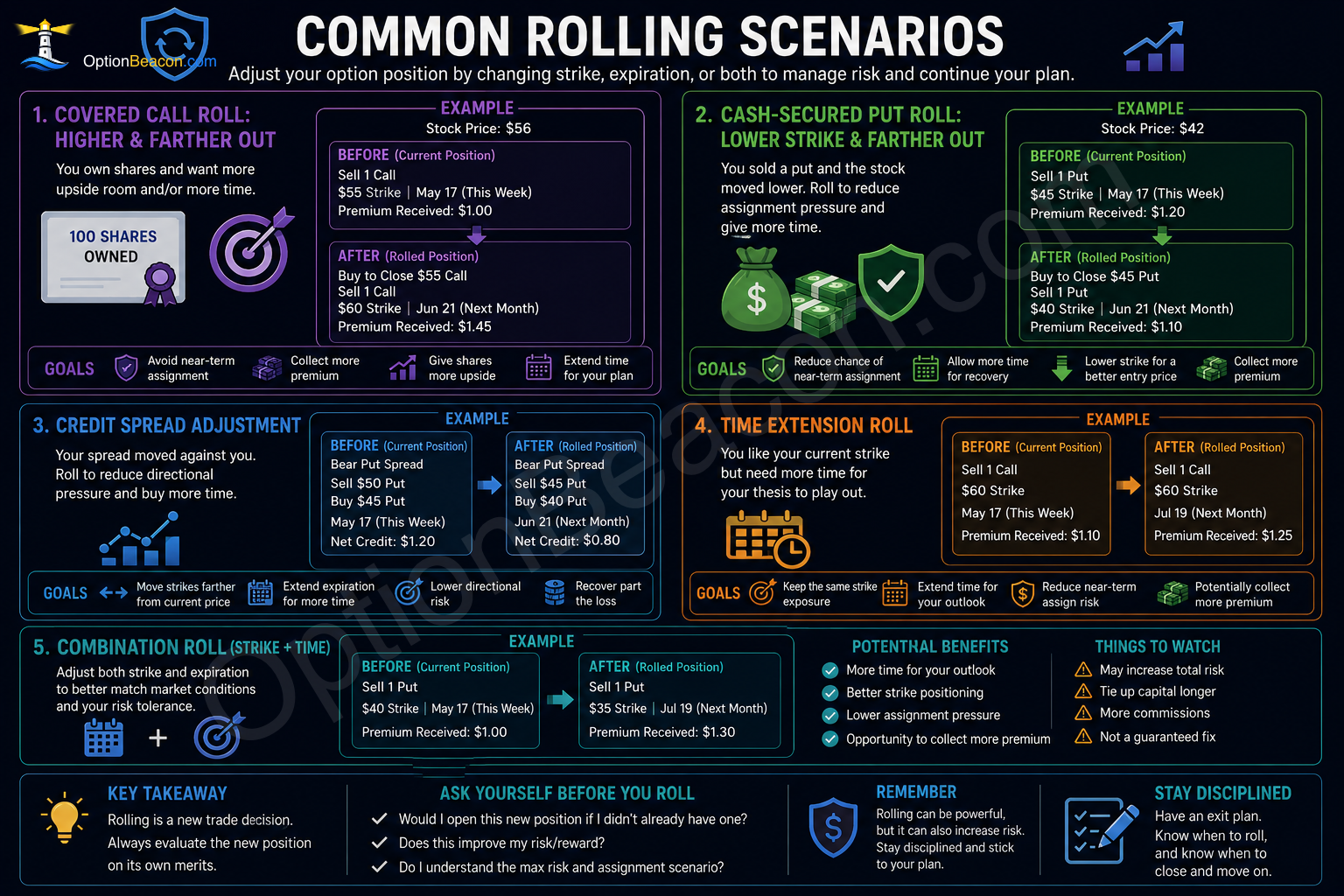
Covered Call Roll
A trader owns shares and sold:
- $55 covered call.
The stock rises near $55 close to expiration.
The trader rolls:
- From $55 strike to $60 strike next month.
Possible goals:
- Avoid assignment.
- Collect more premium.
- Allow more upside room.
Cash-Secured Put Roll
A short put moves in the money as the stock falls.
The trader rolls:
- To a later expiration.
- Possibly to a lower strike.
Possible goals:
- Reduce assignment pressure.
- Allow more recovery time.
- Improve entry positioning.
Credit Spread Roll
A spread moves against the trader.
The trader rolls:
- Farther out in time.
- Farther away from price.
Possible goals:
- Reduce directional pressure.
- Recover partial losses.
Understanding Credit vs Debit Rolls
Credit Roll
A trader receives additional premium.
This often happens when:
- Extending expiration.
- Keeping substantial risk.
- Rolling closer strikes.
Debit Roll
The trader pays additional money.
This may happen when:
- Improving strike positioning.
- Reducing risk.
- Buying more time aggressively.
Important Reality
A credit roll can still worsen overall exposure.
More premium collected does not necessarily mean:
- Safer trade.
- Lower total risk.
- Higher probability of success.
The Biggest Beginner Mistake
Many beginners treat rolling like this:
- If I keep rolling, I have not lost yet.
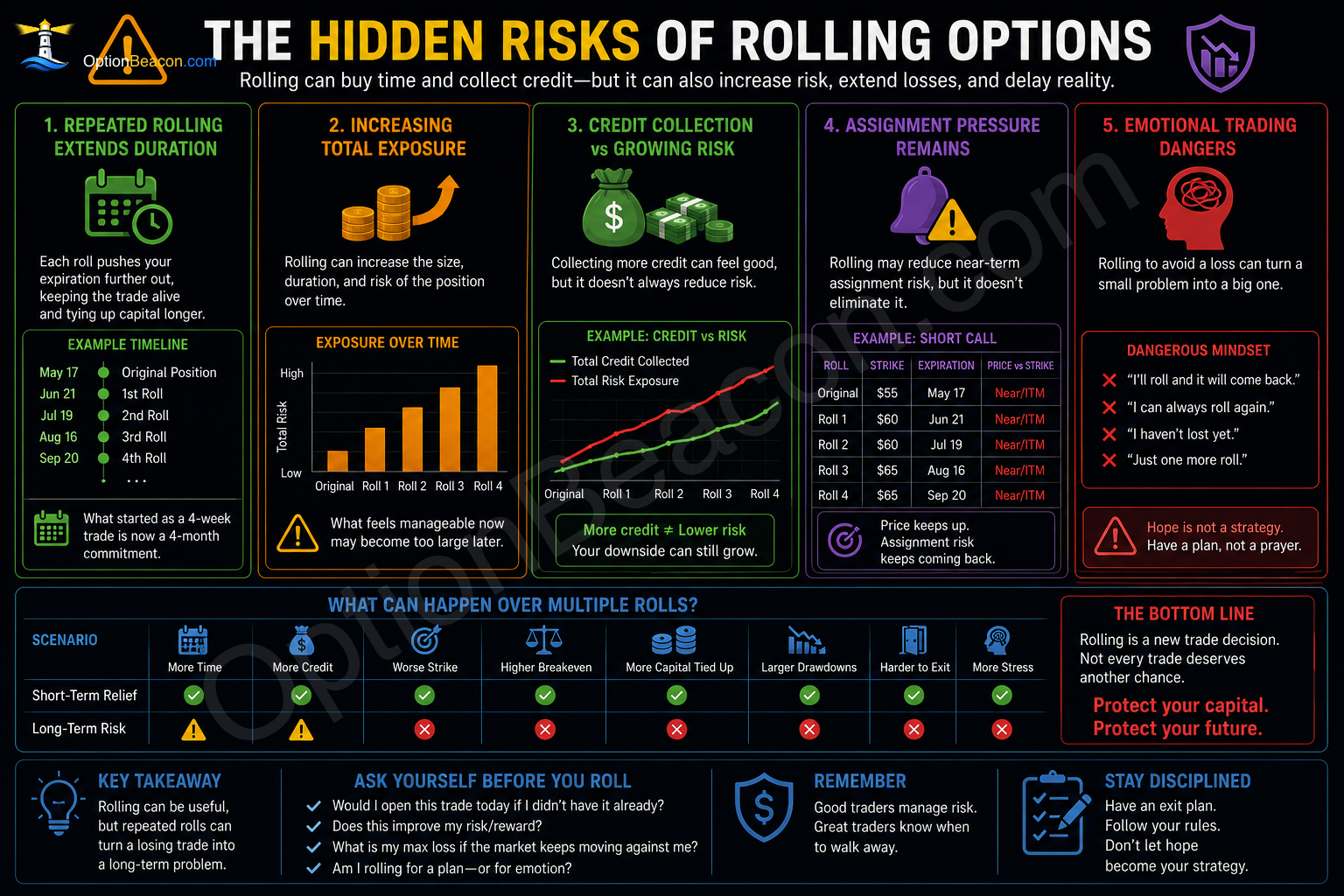
This mindset can become dangerous.
Rolling can:
- Extend losing trades.
- Increase exposure.
- Trap capital.
- Create emotionally driven decisions.
Professionals often ask:
- If I had no existing position, would I open this new trade today?
If the answer is no, the roll may simply be emotional avoidance.
Real Example
A covered call seller owns shares at:
- $50.
They sold:
- $55 call expiring Friday.
The stock rises to:
- $56.
The trader rolls:
1. Buy back the $55 call. 2. Sell next-month $60 call.
Possible outcomes:
| Outcome | Result |
|---|---|
| Stock stays below $60 | Premium retained |
| Stock rises above $60 | Shares may still be called away |
| Stock falls sharply | Trader still owns shares |
Examples are simplified so the mechanics are easier to see. Real trades also include commissions, fees, taxes, changing implied volatility, assignment risk, and execution quality.
Professional Trader Lens
Professionals usually evaluate rolls as:
- An entirely new trade decision.
They focus on:
- Current probability.
- Liquidity.
- Volatility.
- Assignment risk.
- Portfolio exposure.
- Capital efficiency.
Professionals also monitor:
- Cumulative credits collected.
- Cumulative realized losses.
- Adjusted breakeven levels.
- Emotional decision-making.
A professional process usually starts with:
- The underlying stock.
- Volatility conditions.
- Expiration structure.
- Strike positioning.
- Portfolio risk.
- Position sizing.
The option structure expresses the idea — not the idea itself.
Risks and Tradeoffs
Extending Risk Duration
Rolling farther out ties up capital longer.
Larger Total Exposure
Repeated rolls can increase total portfolio risk.
Assignment Can Still Happen
Rolling reduces immediate assignment pressure but does not eliminate future assignment risk.
Debit Rolls Can Worsen Breakeven
Additional debits may increase required recovery.
Emotional Trading Risk
Rolling emotionally can turn manageable losses into large long-term problems.
Common Mistakes
Rolling Automatically
Not every challenged trade should be rolled.
Ignoring Total Position Exposure
Traders sometimes focus only on the latest premium instead of total cumulative risk.
Chasing Credit
High premium often means:
- Elevated volatility.
- Elevated uncertainty.
- Elevated risk.
Rolling Illiquid Contracts
Wide spreads can make rolling expensive.
No Exit Rule
Some traders continue rolling indefinitely without predefined limits.
Most beginner mistakes come from focusing on premium instead of total exposure.
Premium is visible immediately, but the obligation, cumulative risk, drawdown potential, and capital usage matter just as much.
Rolling vs Closing the Trade
Sometimes the cleanest solution is simply:
- Close the trade and move on.
Not every position deserves adjustment.
Good risk management sometimes means accepting:
- Small losses.
- Thesis failure.
- Better opportunities elsewhere.
Practical Checklist
Before rolling:
- Is the new position attractive independently?
- Has volatility changed?
- Has the market thesis changed?
- Is liquidity acceptable?
- What is the cumulative P/L?
- Does the roll improve probability?
- Does the roll increase total exposure?
- Is assignment risk acceptable?
- Is emotion influencing the decision?
Related Beginner Guides
Continue learning:
- Covered Calls Explained
- Cash-Secured Puts Explained
- Options Expiration and Time Decay
- How to Choose the Right Strike Price
- The Greeks: Delta, Gamma, Theta, and Vega
Key Takeaways
- Rolling is a close plus a new opening trade.
- Rolling can change strike, expiration, or both.
- Credit rolls do not automatically reduce risk.
- Rolling can extend exposure and tie up capital.
- Assignment risk may still remain.
- Professionals evaluate rolls as new trades.
- Sometimes closing the trade is cleaner.
FAQ
Is rolling closing a trade?
Yes. A roll closes one position and opens another.
Should losing trades always be rolled?
No. Sometimes accepting a loss and moving on is the cleaner and safer decision.
Does rolling eliminate assignment risk?
No. Rolling may reduce near-term assignment pressure, but assignment can still happen later.
Is a credit roll always good?
Not necessarily. More credit may come with: - More time exposure. - More directional risk. - More volatility risk.
Why do traders roll covered calls?
Usually to: - Avoid assignment. - Collect additional premium. - Allow more upside room.
Can rolling become dangerous?
Yes. Repeated emotional rolling can increase cumulative losses and total portfolio exposure. ## Educational Disclaimer OptionBeacon provides educational content only and does not provide financial, investment, or trading advice.