


Options Basics
What Is an Option? A Beginner's Overview
Learn what an option contract is, how calls and puts work, and what beginners should understand before trading.
Overview
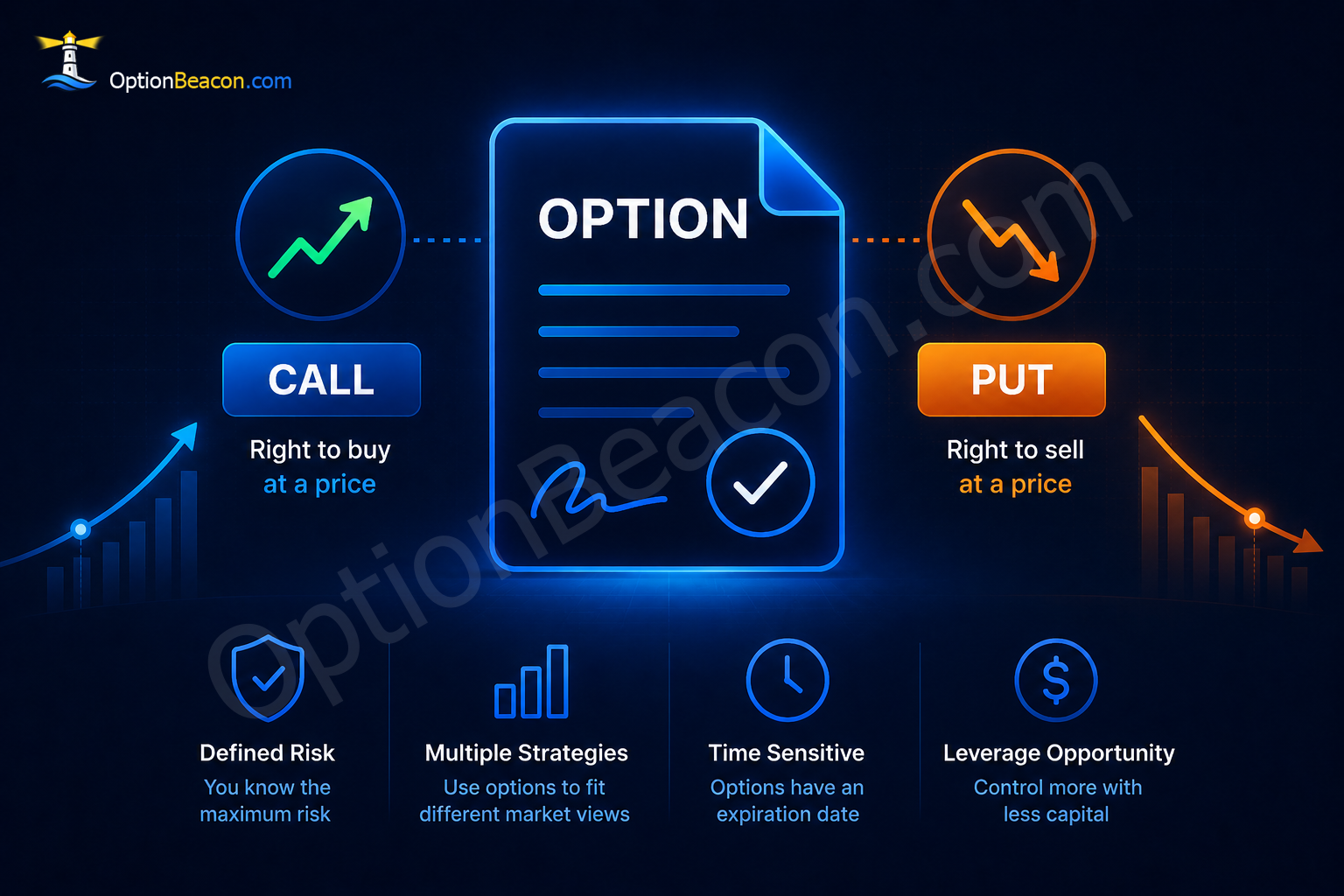
An option is a standardized contract tied to an underlying asset such as a stock, ETF, or index. It gives the buyer a right and gives the seller an obligation. That difference is the first thing every beginner needs to understand.
This guide explains the idea in practical terms. It is written for education, not as a trade recommendation. Before using any options strategy, understand the contract, the maximum realistic loss, the expiration date, liquidity, and what could happen if the position is assigned or exercised.
How It Works
- A call gives the buyer the right to buy at the strike price.
- A put gives the buyer the right to sell at the strike price.
- The buyer pays a premium; the seller receives that premium.
- Most listed equity options represent 100 shares, so small quoted prices can control larger notional exposure.
The important professional habit is to connect the structure to a specific thesis. A trader should be able to say what they expect, what would prove the idea wrong, and how much capital is at risk if the market does something unexpected.
Real Example
If a stock trades at $50 and a trader buys a $55 call for $2.00, the upfront premium is usually $200 per contract. At expiration, the stock would need to be above $57 before the buyer breaks even, ignoring fees. Below $55, the call expires worthless.
Examples are simplified so the mechanics are easier to see. Real trades also include commissions, fees, taxes, changing implied volatility, early assignment risk, and execution quality.
Professional Trader Lens
Professionals do not treat options as lottery tickets. They define the underlying view, time horizon, volatility assumption, and risk limit before choosing a contract.
A professional process usually starts with the underlying first, then volatility, then strategy selection, then position size. The option contract is the expression of the idea, not the idea itself.
Risks and Tradeoffs
- The entire premium can be lost when buying options.
- Selling options can create assignment obligations.
- Time decay and implied volatility changes can matter as much as direction.
Risk should be reviewed before entry and again after the trade changes. Options positions can evolve quickly because delta, gamma, theta, and vega are not static. A position that looked conservative at entry can become aggressive after a large move or as expiration approaches.
Common Mistakes
- Confusing option price with total contract cost.
- Ignoring expiration and liquidity.
- Buying far out-of-the-money contracts only because they look cheap.
Most beginner mistakes come from focusing on premium instead of total exposure. Premium is visible immediately, but the obligation, drawdown, opportunity cost, and assignment scenario matter just as much.
Practical Checklist
- Can you explain the strategy without looking at the order ticket?
- Do you know the maximum planned loss and the realistic worst-case scenario?
- Have you checked bid-ask spread, open interest, and upcoming events?
- Do you know what you will do if the trade moves against you?
- Is the position small enough that you can follow your plan?
FAQ
Is an option the same as stock?
No. Stock is ownership. An option is a contract with rights, obligations, strike price, expiration, and premium.
Can beginners learn options safely?
Beginners can study options safely, but live trading requires position sizing, risk controls, and a clear understanding of assignment and expiration.
What should I learn after this?
Learn calls versus puts, then options chains, expiration, and the Greeks.